

White Label VTOL UAV Simulator Empowers Your Own Branded Flight Training
2026-08-21
Imagine handing your customers a flight training platform that carries your logo, your interface style, and your training philosophy—without the years of development or the overhead of building your own simulator. That’s the reality behind white label VTOL UAV simulation, and it’s changing how drone companies deliver pilot training. With SRIZFLY, you can take a proven VTOL simulation engine, rebrand it under your own name, and offer students a realistic environment to master vertical takeoff, transition flight, and mission planning. In this post, we’ll break down how this model works, why it accelerates your time to market, and how it lets you stand out with a training program that feels entirely yours.
Your Brand, Your Simulator: White Label Freedom
White label freedom means the simulator you deploy is no longer a third-party tool with its own identity—it becomes an extension of your brand, down to the smallest interface detail. Your logo, your color palette, your terminology, your onboarding flow: every element reflects the product experience you want your users to have, not the vendor's. This removes the friction of redirecting customers to an external platform and keeps them immersed in an environment that feels wholly yours.
Beyond aesthetics, white label freedom gives you control over the learning curve. You choose which features surface first, how simulations are categorized, and what language guides the user through each scenario. There's no awkward moment where a user notices a different company's name in the URL or support email. The simulation lives under your domain, your SSL certificate, and your support channels, which reinforces trust and reduces support tickets asking 'why am I on someone else's site?'
For teams building custom training, sales demos, or product onboarding, white label freedom isn't a luxury—it's a necessity for maintaining brand equity. You can embed the simulator directly into your existing LMS or website, pass user data seamlessly, and even customize the analytics dashboard to use your internal reporting jargon. The result is a tool that your clients or employees perceive as a native part of your ecosystem, not an add-on, which strengthens adoption and long-term retention.
Realistic VTOL Handling: From Hover to Forward Flight
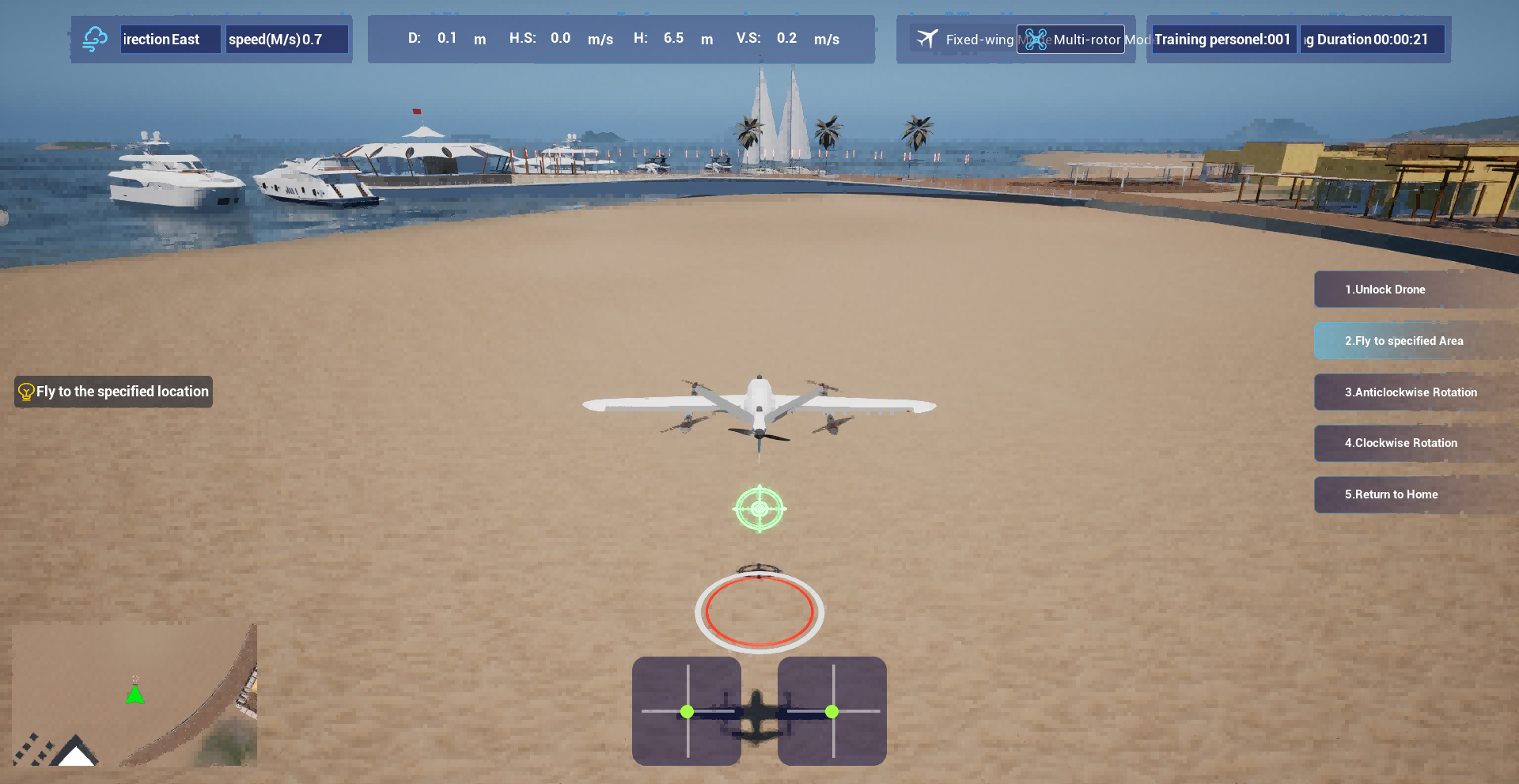
The transition from a stable hover to forward flight in a VTOL aircraft is never a simple flip of a switch. Even in modern designs with tiltrotors or vectored thrust, the pilot has to manage a delicate balance between vertical lift and horizontal acceleration. As the aircraft begins to gain speed, the wings start generating their own lift, which means the need for direct vertical thrust gradually decreases. But if you reduce that vertical component too early or too aggressively, the aircraft sinks; too late and you waste energy fighting unnecessary drag. Getting this blend right feels less like following a checklist and more like coaxing a machine through a fluid, changing state.
Realistic handling also means the control inputs don't feel linear across the entire transition. In hover, pedal input for yaw and cyclic or stick deflection for lateral movement respond almost immediately, but as airspeed builds, aerodynamic surfaces become more effective and the rotor or thrust vectoring system takes on a new role. The aircraft may start to feel 'heavy' in pitch or require constant small corrections to maintain altitude while the nose drops. A good simulation captures these nuances: the slight vibration through the airframe, the change in control harmony, and the way the horizon tilts just before forward flight becomes self-sustaining. It's this granularity that separates a believable VTOL experience from a simplified arcade model.
What many pilots notice first in a high-fidelity VTOL module is the need to unlearn habits from conventional airplanes. There's a moment during acceleration where the aircraft is neither hovering nor truly flying on the wing — it's a region of heightened sensitivity and reduced stability margins. You might feel the nose want to pitch up or down without a corresponding stick command, or the roll response becomes sluggish as the flaps and rotors interact with the wake. To fly through this phase smoothly, you learn to anticipate rather than react, using small, deliberate pressure on the controls and trusting instruments over physical sensation. That's the essence of realistic VTOL handling: the transition isn't just a speed range, it's a skill earned through repeated exposure to the messy, dynamic middle ground between two distinct flight regimes.
Train Smarter: Scenario Drills for Every Mission Profile
Most training plans fall apart because they treat every day like a blank slate. Scenario drills that map to actual mission profiles force you to make decisions under the same constraints you'll face. Instead of just running laps or shooting static targets, build a drill around a specific profile: night patrol in an unfamiliar urban grid, a two-person rescue in a collapsed structure, or long-range movement with a heavy pack after sleep deprivation. The value comes from stacking small, realistic frictions—communication delays, equipment swaps, sudden route changes—so your body and brain stop treating them as surprises.
A useful trick is to name the drill after the job, not the exercise. Call it "downed pilot extraction" rather than "sprint circuit." That mental framing changes how you approach rest periods, gear selection, and even breathing. Write the profile on an index card before you start: what the environment looks like, who else is involved, what the failure state costs. Then run the drill cold, without a walkthrough. You'll make mistakes, but each mistake points to a specific gap in preparation instead of a vague sense of being out of shape.
Rotate through profiles weekly rather than perfecting one. A fire team leader doesn't need to master only breaching; they need to shift from vehicle interdiction to building clearance to casualty evacuation without losing focus. Scenario drills built around distinct mission profiles train the transition itself. Keep a simple log of which profile you trained, the time it took, and one thing that broke down. Over a month, you'll see patterns that no amount of generic conditioning would reveal.
Budget-Friendly Flight Hours: Virtual Training That Pays Off
Real cockpit time can drain a training budget faster than a jet burns fuel on takeoff. Virtual flight hours flip that cost curve without cutting corners on skill-building. You still work through checklists, practice radio calls, and manage emergencies—just without the hourly rental fee, instructor standby charges, or weather delays. Many student pilots now log more simulated approaches in a month than they would in a year of traditional rental bookings.
The payoff shows up when you finally slide into the left seat for real. Muscle memory from a good sim setup carries over: your scan pattern feels natural, your altitude calls come faster, and you already know how to stay ahead of the aircraft. That means fewer paid hours wasted on relearning basics and more time polishing the maneuvers that actually need real-air feedback. In the end, virtual training doesn't replace real flight—it makes every real hour count double.
Grow on Demand: Scalable Simulator Access for Any Fleet Size
Scaling simulator access shouldn't feel like a hardware procurement project. Most teams end up either overpaying for idle capacity or hitting a wall when they need to onboard a second shift of operators overnight. The real fix is elastic access, where the simulation environment expands and contracts with your actual test demands, not your quarterly budget cycle.
When a fleet grows from a dozen prototypes to several hundred vehicles, the load on your simulation stack changes character entirely. A rigid license server or fixed node count becomes the bottleneck before you even notice. Instead, the system should let you spin up hundreds of parallel instances during a regression sprint, then drop back to a handful for daily development, all without renegotiating contracts or filing tickets.
The practical advantage shows up in mixed fleets too. One week you might be testing a compact urban shuttle, the next a heavy-duty truck with a different sensor suite. On-demand capacity means you don't have to pre-provision for the worst-case scenario. You simply request what the current integration cycle needs, run the scenarios, and release the resources. That's how simulation stops being a fixed cost and starts behaving like a utility that matches your engineering tempo.
Plug-and-Play Curriculum Integration for Flight Schools
Flight schools often wrestle with curriculum updates that demand months of rework, instructor retraining, and downtime. A plug-and-play approach flips that script. Instead of rebuilding lesson plans from scratch, schools can drop in ready-made modules covering everything from private pilot ground school to instrument rating prep. Each module slots into the existing syllabus with clear objectives, checkride alignment, and instructor notes, so there is no guesswork about sequencing or FAA compliance.
What makes this model work in real hangars is flexibility without fragmentation. A school might keep its own flight training devices and aircraft fleet while swapping in a new weather theory unit or a scenario-based decision-making block. The modules are designed to be standalone yet coherent, so students experience a seamless progression rather than a patchwork of borrowed materials. Instructors appreciate that each package includes assessment rubrics and common student pitfalls, which cuts briefing time and keeps training consistent across different CFIs.
Beyond saving hours, this integration method supports rapid adaptation to regulatory shifts or new technology. When glass cockpit avionics became standard, many schools struggled to retrofit their curricula. Plug-and-play modules let them add a G1000 transition block one week and a risk-management seminar the next, all without pausing enrollment. The result is a training program that feels current and personalized, not off-the-shelf, because the school still controls the overall arc while leaning on battle-tested building blocks.
FAQ
It means you get a fully built flight training tool that you can present as your own. You control the branding, user interface, course content, and even the scoring logic, so pilots see your company at every step.
Absolutely. You can replace logos, adjust color schemes, insert your own checklists, and design pass/fail thresholds around the maneuvers your clients care about most.
The model captures the tricky conversion corridor, including lift changes, control surface blending, and wind effects. Pilots can repeat the transition until it feels natural, which is hard to do safely on a real aircraft.
You can set up normal procedures, engine-out practice, sensor degradation, GPS loss, night ops, and even mission profiles like powerline inspection or coastal patrol. Most scenario editing is menu-driven.
Yes. You can choose from several airframe types or work with the vendor to add a custom model, so the simulator matches the aircraft your trainees will actually fly.
A standard rebrand can often go live in two to four weeks. If you want custom aircraft models or unique failure modes, that adds more time, but you're still avoiding years of in-house development.
Yes. The system logs every flight and generates debrief files that you can style with your branding. You decide what metrics matter and whether the results are shown to trainees or only to instructors.
Conclusion
A white label VTOL UAV simulator gives flight schools and drone service providers a rare advantage: the ability to put their own name, logo, and training philosophy directly on a professional-grade simulation platform. Gone are the days of settling for generic software that undercuts your identity. Your brand becomes the interface, the certificate, and the first thing students see when they power up. Underneath that customization sits flight physics that respect the unique challenge of VTOL aircraft. Students can practice the delicate transition from vertical hover into efficient forward flight and back again, building muscle memory without risking an airframe. Rather than repeating the same basic drills, instructors can design mission-specific scenario sets—power line inspection, coastal survey, emergency response, urban package delivery—so every session feels purposeful and aligned with real operations.
The financial argument is just as compelling. Virtual hours cost a fraction of real flight time, letting trainees make mistakes, repeat maneuvers, and refine judgment long before they touch a physical drone. This reduces wear on your fleet and gives you a predictable training budget without sacrificing quality. Because access is subscription-based and scalable, a two-person startup and a multi-campus academy can both find a plan that fits. Adding ten more trainees is as simple as issuing credentials, not buying hardware. For flight schools, the simulator plugs into your existing curriculum without forcing a rebuild—lesson plans, progress tracking, and checkride prep can all be mapped onto the platform. The result is a training environment that feels like an extension of your operation, not a third-party afterthought, and one that quietly builds your reputation with every logged hour.
Contact Us
Contact Person: Niles Liu
Email: [email protected]
Tel/WhatsApp: 8619945009803
Website: https://srizfly.com/