

Strong Magnet Factory: Inside the Craft of High-Performance Magnets
2026-10-16
There's a moment in every high-performance magnet factory when the alloy stops being a recipe and starts behaving like a material with its own temperament. Hit the quenching rate too slow or the alignment field too weak, and the magnet never reaches its potential. At DAWA, this tightrope walk between chemistry and physics is treated as craft, not convention. Here's a look inside the process—and the obsessive details—that separate magnets that merely stick from magnets that push entire industries forward.
Mixing the Magnetic Soup: Alloy Secrets from the Factory Floor
The magnetic soup doesn't come from a recipe card. The ladle tilts and a slow river of nickel-iron glows orange-white as it folds into the induction furnace. On the floor, the old hands watch the surface ripple more than the thermocouple readout; they know the melt is ready when the oxide skin breaks into drifting islands instead of a solid lid. That first stir is never gentle. You want the magnetic phases to form in a hurry, but not so fast they lock in brittle dendrites before the cobalt and chromium have time to wander through the liquid. A long, low-amperage stir beats a violent one every time, even if it costs another twenty minutes of argon cover gas.
The scrap yard sends a batch of motor laminations with a little too much silicon, and suddenly the permeability drops unless you add a touch of aluminum to steal the oxygen. No two heats behave the same, so the floor supervisors keep a chalkboard near the spectro lab—not for logging, but for the running bets on how much ferroniobium the next pour will need. That kind of knowledge doesn't come from phase diagrams. It comes from hearing the hum of the coil change pitch when the melt is just short of pouring, or from smelling the burnt cardboard odor of a slag that has gone slightly acidic.
Once the slabs are cast, the quiet part of the job starts. They sit in a temperature-gradient tunnel where the cooling fans are deliberately unbalanced to push grain growth along one axis. No one writes down the exact fan angles. The maintenance crew adjusts them by ear, aiming for a faint rattle that means the airflow is shearing off the mold wall at the right angle. A fully balanced fan array makes the magnetic domains too round, too polite. You want a little asymmetry in the cooling so the domain walls move with less resistance when the part finally goes into a motor. That asymmetry is the difference between a core that whines at 60 hertz and one that runs silent under load.
Pressing Power: The Hydraulic Birth of a Permanent Field
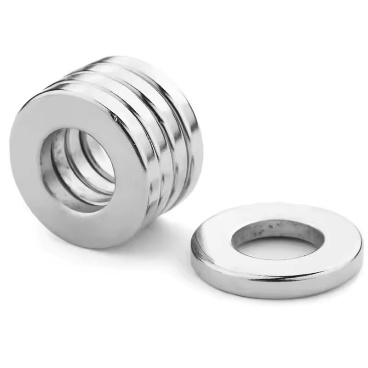
In a hydraulic press, loose magnetic powder is squeezed into a die cavity under hundreds of tons. The pressure not only compacts the particles but also locks their orientation, giving the future magnet its axis of magnetization. This is not a gentle shaping; it's a brutal consolidation where every grain is forced into near-perfect alignment while the die walls hold the shape.
The resulting "green" compact may look dull and fragile, but inside it already carries the blueprint of a permanent field. Later sintering fuses the particles without undoing that alignment, and what emerges is a solid that refuses to lose its magnetism. The hydraulic step, often overlooked, is where the field is truly born—not from coils or currents, but from raw, unyielding pressure.
Without this pressing stage, the powder would remain just powder, its magnetic domains scattered and weak. The press gives it density and direction, turning chaos into a single, stubborn polarity. That's why a magnet fresh from the press already shows a weak attraction even before it's fully hardened; the permanent field has already started to speak.
Sintering in the Hot Zone: Where Powder Becomes Magnet
Inside the hot zone, loose magnetic powder stops being a mere collection of particles and starts acting like a solid body. Temperatures climb high enough to soften grain boundaries without fully melting the bulk, so atoms migrate just enough to fuse neighboring particles into a continuous network. The result is a dense, rigid structure that still holds the magnetic alignment locked in from earlier processing steps.
What makes this stage tricky is the balance between heat and time. Push too hot or too long, and grain growth erases the fine microstructure that gives a magnet its coercivity. Too cool or too brief, and the part remains porous and weak. Operators watch the glow inside the furnace, track thermal profiles, and adjust atmosphere flow to keep oxygen away from the reactive powder. Each batch leaves the hot zone with a dark, solid form that no longer resembles the gray dust that entered.
After cooling, the material has become a true magnet blank—ready for grinding, coating, and final magnetization. The hot zone does the quiet work of turning powder into a dense metallic body, and every choice made there shapes how strongly the finished magnet will hold its field.
Grinding to Micron Precision: Shaping the Invisible Force
Precision grinding doesn’t announce itself with sparks and noise alone—its real story lives in a space too small for the naked eye. Holding a tolerance of a few microns means every pass of the wheel removes material thinner than a fingerprint ridge, yet the forces behind that removal remain largely unseen. They show up as heat, vibration, and elastic deflection, each one quietly steering the final dimension away from intent.
The craft lies in reading those invisible cues. A slight change in feed rate alters the contact stiffness; a tiny imbalance in the spindle translates into surface ripples measured in nanometers. Experienced operators don’t just watch the readout—they listen to the grind, feel the table’s rhythm, and adjust coolant flow before the workpiece ever drifts out of spec. That’s how micron-level work becomes less about chasing numbers and more about shaping the forces you can’t see.
When a part leaves the grinder within two microns of nominal, it’s tempting to credit the machine alone. But repeatable precision comes from managing what instruments barely register: thermal growth in the column, wheel wear compensation, the microscopic dressing pattern left by a diamond. Shape those correctly, and the invisible force becomes a tool instead of an obstacle.
The Charging Chamber: One Millisecond to Full Magnetism
Inside the charging chamber, time bends to a brutal kind of efficiency. A single millisecond is all it takes for the magnetic core to snap from dormant iron to a saturated field density that would rip the fillings from your teeth if you stood too close. There's no ramp-up whine, no gradual hum—just a violent, silent lurch that feels like the air itself gets squeezed into a smaller shape.
What makes this near-instant charging possible isn't some exotic power source, but a cascading collapse of pre-staged capacitors arranged in concentric rings. Each ring discharges into the next with a timing error measured in picoseconds, building a pressure wave of electrons that slams into the coil assembly. The result is a magnetic pulse so sharp it rewrites the local permeability of the chamber walls, briefly turning them into a temporary magnetic lens before they relax back to ordinary steel.
For anyone who's ever waited on a slow charger, this feels less like an engineering solution and more like a loophole in physics. The chamber doesn't 'fill up' with magnetism—it ambushes the magnetic field into existence. And once the millisecond passes, the system is already bleeding off the excess into a heat exchanger that glows faintly cherry-red for the next few seconds, as if embarrassed by its own speed.
Proving Grounds: How We Test for Pull, Heat, and Lifespan
Every product we put our name on gets dragged through a battery of tests that would make most engineers wince. Pull strength isn't just about yanking on a seam until it gives—we use a calibrated tensile rig that applies force in multiple directions, mimicking the awkward angles of real-world use like a loaded backpack swinging off one shoulder. Heat testing goes beyond a simple oven bake; we cycle materials from sub-zero cold to desert-level heat with rapid transitions, because the real enemy is thermal shock, not steady warmth. And lifespan? We run accelerated wear simulators that compress years of daily abuse into weeks, tracking everything from stitch degradation to zipper tooth fatigue.
What sets our process apart is that we don't test to a pass/fail checklist. Instead, we measure failure modes and then tweak the design until the failure happens in an acceptable, predictable way—never catastrophically. A strap that slowly frays after five years of hard use is fine; a buckle that snaps without warning in month six is not. This philosophy means our lab reports read more like post-mortems than certificates, and that's exactly how we like it.
We also pull in real users for blind field testing, handing them prototypes with no branding and asking them to log every snag, rub, or moment of doubt. Their feedback gets cross-referenced with our instrument data, and if a material passes our machines but fails a human's intuition, it goes back to the drawing board. That loop—lab to living and back again—is why we trust our gear to outlast the season it was bought in.
FAQ
Neodymium-iron-boron alloys form the backbone, often blended with dysprosium or terbium to preserve magnetic strength at elevated temperatures. Samarium-cobalt also appears for demanding thermal environments.
Before sintering, the powdered alloy is pressed in a powerful external magnetic field, forcing the tiny grains to orient along a single axis. This alignment is what gives the finished magnet its direction-dependent pull.
Sintering fuses the compacted powder into a dense solid at temperatures just below melting point. Without it, the magnet would be brittle and magnetically weak because the grains would not bond tightly enough.
Technicians use a fluxmeter to map the magnetic field, a gaussmeter for surface strength, and salt-spray chambers to test corrosion resistance. Dimensional checks with laser micrometers catch shape deviations early.
A three-layer coating is common: a nickel-copper-nickel sandwich applied by electroplating. Some factories also offer epoxy or parylene coatings for harsh environments like marine or medical settings.
You find them in electric vehicle motors, wind turbine generators, MRI machines, smartphone haptics, and even high-end audio drivers where precise magnetic force is non-negotiable.
Maintaining uniform grain size and alignment across larger batches is hard. Even small oxygen contamination during handling can wreck magnetic performance, so the factory uses glove boxes and inert gas atmospheres.
Yes, scrap from machining and rejected parts can be re-milled into powder, but the recycled material often needs careful re-alloying because the original grain structure and coating additives alter the melt chemistry.
Conclusion
On the factory floor, the process starts with a metallic soup that is anything but random. Neodymium, iron, boron, and small doses of dysprosium or cobalt are blended under a controlled atmosphere, because even a trace of oxygen can poison the final magnet's performance. Once the alloy powder meets spec, it goes under a hydraulic press. Tons of force compact the powder while a magnetic field aligns each particle, setting the direction of future pull. The compact is still fragile, so sintering takes over: the pressed shape goes into a high-temperature furnace where it shrinks and fuses into a dense, solid block. The furnace atmosphere and heating curve matter just as much as the alloy itself—rush it and cracks appear; run it too cool and the magnet never reaches full density.
After sintering, the magnet is rough and slightly oversized. Grinding to micron precision isn't just about looks; it fixes the exact dimensions needed for the magnetic circuit and strips away any oxidized skin from the furnace. Then comes the charging chamber, where a capacitor bank dumps a huge current through a coil in under a millisecond. That single pulse flips the magnetic domains into full alignment, turning dead metal into a permanent magnet with a clear north and south. No batch leaves without proof, though. In the testing area, samples get pulled, heated, and cycled to check coercivity, remanence, and long-term stability. The result is a component that might end up in an electric motor, a wind turbine, or an MRI machine—an invisible force engineered down to the micron.
Contact Us
Contact Person: Kelvin Lo
Email: [email protected]
Tel/WhatsApp: 0769-88561131
Website: https://dawamagnetic.com/