

Silicon Carbide Powder Factory Essentials for High-Performance Ceramic Manufacturing
2026-11-02
Not all silicon carbide powder starts out equal—and neither do the factories producing it. For high-performance ceramic manufacturing, the difference between a reliable batch and a costly failure often comes down to a handful of factory essentials: raw material purity, particle size distribution, sintering behaviour, and quality traceability. That’s why HUAYI TECH focuses on the details most suppliers treat as footnotes. In this post, we’ll walk through what to look for in a silicon carbide powder factory before it becomes the weakest link in your ceramic line.
SiC Powder Purity: Where Real Problems Start
Most suppliers quote 99.9% or even 99.99% purity, but those numbers rarely tell the whole story. The real trouble hides in the fine print: metallic contaminants like iron, nickel, and chromium that seed defects during crystal growth, or oxygen and nitrogen that shift resistivity in ways you only discover after the wafer is polished.
Purity specs often ignore particle size distribution and the presence of free carbon or silicon. A batch can pass chemical assay yet still produce excessive micropipes or polytype inclusions because those impurities are not uniformly distributed. When powder sits in storage, surface oxidation quietly raises oxygen content, so even a certified lot can underperform if it has aged.
In practice, the gap between nominal purity and usable purity shows up first in yield loss. That is why experienced growers track lot-to-lot consistency rather than chasing a single impressive assay number. If the powder supplier cannot provide detailed contamination maps and storage history, the problems have already begun before the furnace is loaded.
Particle Shape and Size: Two Levers for Sintering Density
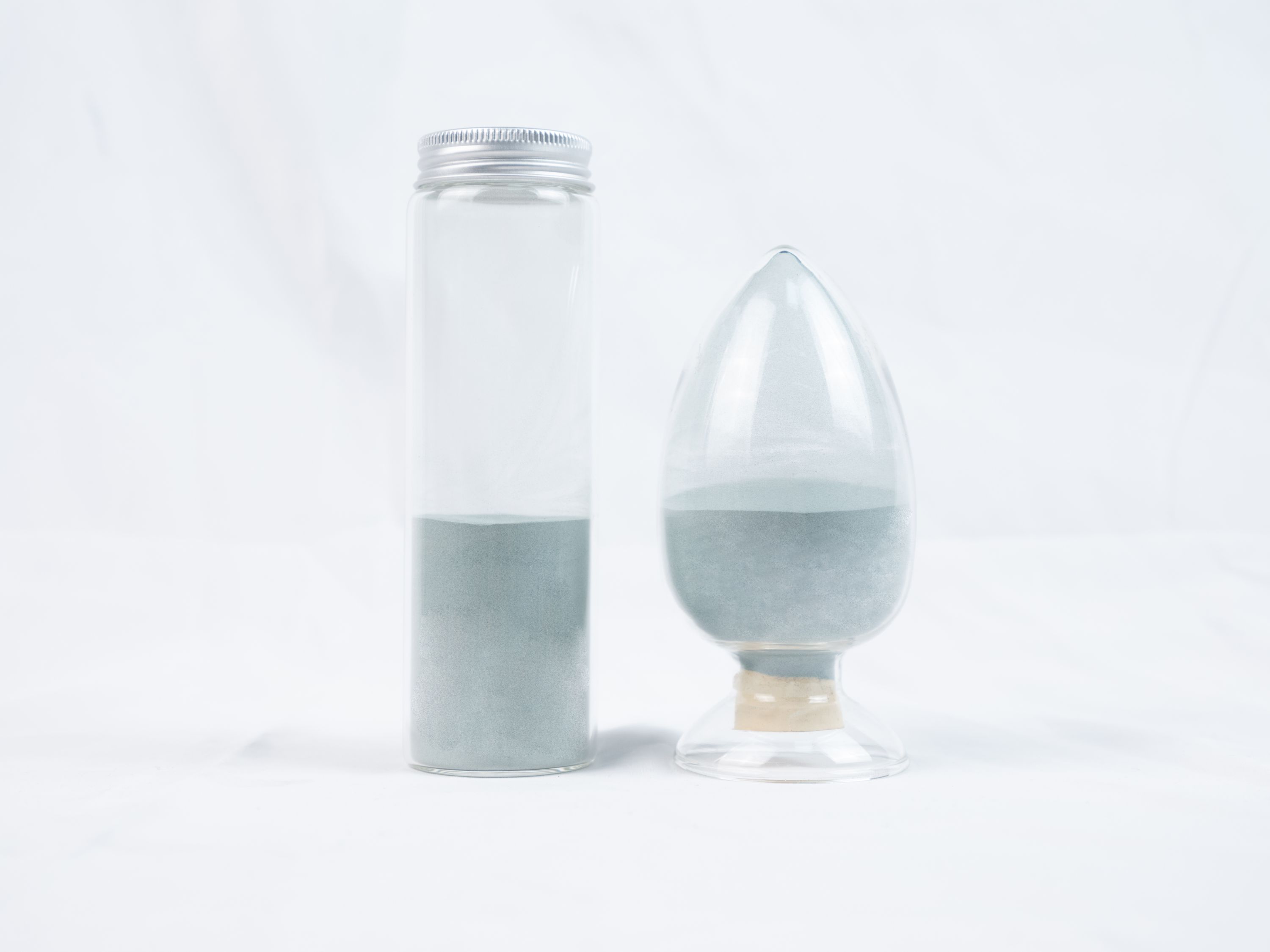
In powder metallurgy and ceramic processing, the path to a dense sintered body starts long before the furnace reaches peak temperature. Particle size acts as a direct control on the driving force for densification: finer powders carry more surface energy per unit volume, which accelerates neck growth and pore elimination during the early and intermediate stages of sintering. However, the benefit is not unlimited. Submicron particles tend to agglomerate, creating large inter-agglomerate pores that behave like coarse defects and resist closure. Thus, the real lever is not simply “smaller is better” but a well-chosen size distribution that balances reactivity with uniform packing.
Particle shape is equally decisive, yet its influence is often underestimated. Spherical or equiaxed particles slide past one another during compaction, yielding a green body with narrow, evenly distributed pore channels. During sintering, these channels shrink uniformly, producing a predictable and high final density. Irregular shapes—flakes, needles, or highly angular fragments—can increase green strength through mechanical interlocking, but they also create wide, irregular pores and anisotropic shrinkage. Such pores may collapse unevenly or become trapped inside grains, limiting the attainable density. In some systems, a controlled fraction of elongated particles can actually aid densification by bridging gaps and enhancing particle rearrangement, but only when the overall shape distribution is carefully managed.
Treating particle shape and size as independent levers misses the point: they interact strongly. A bimodal size distribution with rounded fine particles filling the voids between coarser rounded particles can push green density above 70% of theoretical, after which sintering has less porosity to remove. Conversely, mixing fine spherical particles with coarse angular ones often disrupts packing and introduces localized density gradients that lead to warpage or cracking. Process engineers who map this interplay—through tap density tests, particle image analysis, and sintering dilatometry—can tune both levers to achieve near-full density without resorting to extreme temperatures or long hold times.
What Trace Elements Do to High-Temperature Strength
Trace elements—often present at parts-per-million levels—can shift high-temperature strength in ways that far outweigh their concentration. Boron, for instance, segregates to grain boundaries and suppresses cavity nucleation during creep, while zirconium ties up sulfur and oxygen that would otherwise weaken interfaces. In nickel-base superalloys, small additions of carbon and boron form grain-boundary carbides and borides that resist sliding, effectively raising the temperature at which the alloy can sustain a given stress.
Not every trace addition helps, though. Elements like lead, bismuth, and selenium lower the melting point of grain-boundary films or embrittle interfaces, so a few tens of ppm can cut rupture life by half. The practical trick is to treat trace elements as part of the alloy design rather than impurities to be tolerated—controlling their partitioning and avoiding harmful tramp elements can extend service life under load at elevated temperatures more reliably than simply increasing the primary alloying content.
Flow Behavior That Determines Green Part Uniformity
The way powder flows into a die cavity is rarely a simple, uniform fill. Particles tend to bridge, segregate by size or shape, and respond to localized shear rates during filling, which creates density gradients before compaction even starts. A powder that flows too freely under gravity may pack densely near the fill shoe exit while leaving sparse regions near cavity walls, while a cohesive powder can form stable arches that trap low-density pockets. These initial density variations are not erased by pressing; instead, they are often amplified because the compaction force follows the path of least resistance through already dense zones.
During actual compaction, flow behavior shifts from bulk particle movement to localized sliding and rearrangement under pressure. If the powder cannot redistribute laterally due to interparticle friction or die wall friction, the pressure decays rapidly away from the punch face. That creates a green part with a compacted shell and a softer core, or with distinct density bands that follow the pattern of internal shear. Uniformity therefore depends on how readily the particle assembly can flow and densify as a coherent mass rather than as isolated regions. Small changes in particle morphology, moisture content, or lubricant distribution can alter this flow response enough to produce measurable differences in green density from one part to the next.
Practical control of green part uniformity involves watching how the powder behaves in the feed shoe, its angle of repose, and its tendency to aerate or deaerate during transfer. A powder that avalanches intermittently will fill the cavity inconsistently, while one that settles too quickly may block uniform filling of thin sections. Adjusting particle size distribution to improve flow without sacrificing compressibility, or using lubricants that reduce die wall friction without creating segregated layers, helps maintain consistent density. Ultimately, green part uniformity is less about achieving perfectly uniform flow and more about managing the specific flow defects that cause localized density variation in a given geometry.
Keeping Every Batch Within a Narrow Performance Window
Manufacturing consistency rarely happens by accident. When each batch must land inside a tight performance window, every variable matters—from raw material lot variations to subtle shifts in equipment calibration. We treat the window not as a target to hit occasionally, but as a constraint that shapes how processes are designed in the first place.
One practical approach is to identify the few inputs that genuinely move the output, then monitor those relentlessly. Instead of relying on end-of-line testing to catch drift, we pull real-time data from the line and adjust before a batch strays. This feedback loop narrows variation naturally, because corrections happen in minutes rather than after an entire run is complete.
That discipline also changes how operators think. Rather than chasing the center of a spec, they learn to recognize the edge of acceptable performance and act before reaching it. The result is a process that stays predictable—batch after batch, without heroic interventions.
Choosing Powder Features Around Your Ceramic Process
Powder characteristics shape every downstream step in ceramic processing, but the ones that matter most depend heavily on whether you are dry pressing, slip casting, tape casting, or extruding. A particle size distribution that gives excellent green density for uniaxial pressing may create uneven settling or slow casting rates in a slurry system. Instead of chasing a universal ideal powder, start by mapping the forming route’s sensitivity to fines, agglomerate strength, and surface chemistry.
For pressing, pay close attention to flowability and fill density. Granulated powders with a controlled amount of binder and a narrow agglomerate size range usually fill dies more consistently and reduce lamination defects. In colloidal routes like slip casting or gelcasting, particle surface area and zeta potential often outweigh raw particle size; a high surface area can raise viscosity substantially, while a well-chosen dispersant package can offset that. Keep binder burnout in mind too—residual carbon from an aggressive binder system can shift the sintering atmosphere locally and alter final microstructure.
Ultimately, select powder features by working backward from the sintering response you need. If dimensional tolerance is tight, a powder with reproducible shrinkage and low anisotropic particle shape may save more effort than one with slightly higher purity. Run simple bench tests with your actual forming equipment and binder system before committing to a large lot, because subtle differences in moisture uptake, agglomerate hardness, or surface oxidation often show up only under production conditions.
FAQ
Particle size distribution, alpha-phase content, and trace impurity levels are the big three. A narrow distribution around a target median helps with densification, alpha content above 90% supports high-temperature strength, and keeping iron, aluminum, and free silicon low prevents unwanted grain boundary phases.
Most use a combination of air classification and laser diffraction checks every few hours. Some plants also run milling curves on incoming lots to adjust classifier settings before full production, which reduces variation between batches.
Surface oxygen forms silica layers that can hinder sintering and lower thermal conductivity. Keeping oxygen below maybe 0.5% by weight often requires handling powder under nitrogen or in vacuum, plus using coated storage containers.
Additives like boron, carbon, or aluminum compounds are often pre-blended into specialty grades. Factories that offer pre-mixed powders save ceramic manufacturers from doing their own blending, but they need to document additive distribution to avoid localized grain growth.
They typically press test bars and run a reference sintering cycle, then measure density and shrinkage. Some also check green density after pressing at a fixed pressure, since that correlates with final density for a given powder lot.
Dust containment is critical, both for worker safety and cross-contamination. Negative-pressure milling rooms, HEPA filtration on exhaust, and dedicated lines for high-purity grades help keep the powder clean and the workplace safe.
Yes. For slip casting they might adjust surface chemistry and dispersant compatibility; for dry pressing they focus on flowability and granule strength. Some factories run pilot-scale forming trials to fine-tune a powder for a customer’s exact process.
Certificate of analysis covering particle size, phase composition, impurities, oxygen, and sometimes green density. Batch traceability records and retained samples for a set period are also standard in serious factories.
Conclusion
Silicon carbide powder quality dictates what a ceramic body can become before the first firing ever happens. Purity problems rarely announce themselves in raw material certificates; they surface later as exaggerated grain growth, reduced sintered density, or brittle fracture under load. Particle shape and size distribution act as two levers that determine how tightly the green compact packs, and even a slight shift in the fines content can leave the final part short of the target density. Trace elements such as iron, aluminum, or free carbon do not simply sit idle—they alter the oxide film on SiC grains and change how grain boundaries behave at high temperature, which directly erodes creep resistance and hot strength.
A powder that looks consistent in a spec sheet can still behave unpredictably in the press if its flow character varies. Poor or erratic flow creates density gradients in the green state, which later translate into warpage or internal stress after sintering. Tight batch-to-batch control is not about chasing a single number; it means holding the entire particle distribution, surface chemistry, and moisture level within a narrow band so the process stays reproducible without constant parameter tweaks. Smart powder selection starts from the ceramic process itself—whether it is pressureless sintering, hot pressing, or reaction bonding—because each route demands different compromises in particle size, purity, and morphology.
Contact Us
Contact Person: Junting Leo
Email: [email protected]
Tel/WhatsApp: +86 18615009766
Website: https://www.huayimaterial-china.com/