

Sewer Jetting Machines Factory in China Supplying Powerful Drain Cleaning Equipment Worldwide
2026-11-02
Blocked drains don’t wait for convenient hours—and neither should your equipment. Deep in China’s industrial heartland, a factory is quietly redefining how cities and contractors tackle the toughest clogs. Meet AMJET, a manufacturer of high-pressure sewer jetting machines built to blast through grease, roots, and debris with precision. From municipal networks to remote construction sites, their powerful drain cleaning systems are now shipped to over 40 countries, proving that world-class engineering doesn’t need a familiar name—just relentless performance. Curious what makes these machines the go-to choice for crews who can’t afford downtime? Read on.
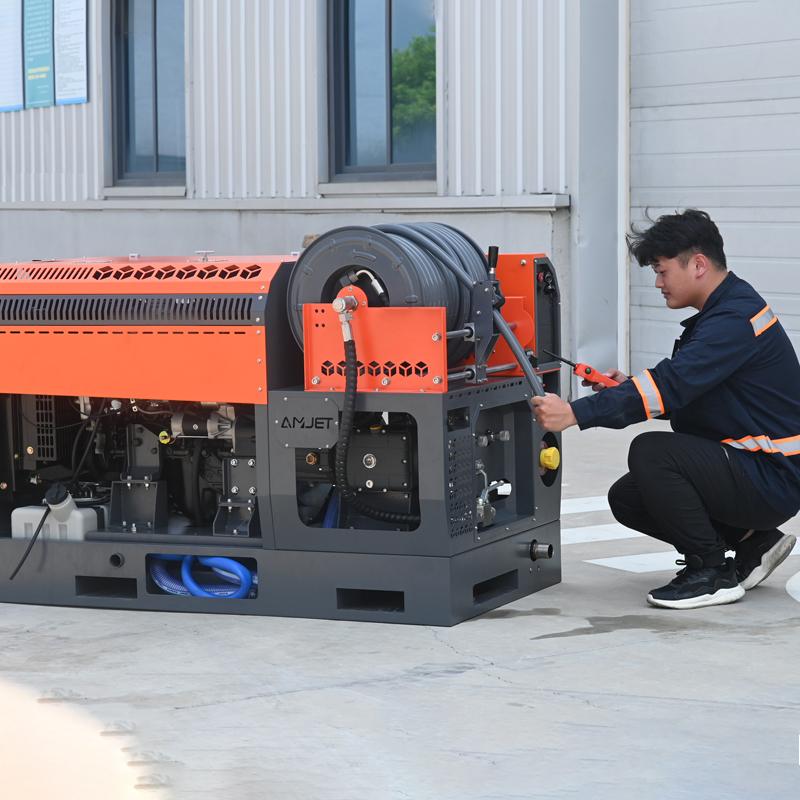
The Floor Where High-Pressure Jetting Units Are Assembled
Stepping onto the assembly floor, the first thing you notice is the low ceiling grid of overhead rails and chain hoists, each rated for the heaviest pump-and-engine packages. Workstations are arranged in a rough U-shape, with preset torque wrenches hanging at every other station and mobile carts carrying pre-cut high-pressure hoses, stainless fittings, and copper sealing washers. The floor itself is sealed concrete, marked with yellow walkways that keep foot traffic away from the hydraulic test loops.
Assembly starts with the triplex pump head being lowered onto its gearbox and aligned with two locating dowels. Technicians follow a step-by-step torque sequence using digital wrenches that log every reading against the unit's serial number. Then the unloader valve, pressure gauge, and safety relief valve are fitted, followed by pre-bent steel tubing that reduces the number of potential leak points. The control panel is mounted on four rubber isolators and wired in place before the first power-on check.
Once fully built, each unit moves to the test bay, where it is clamped to a closed-loop water line. The operator starts with a low-pressure purge to remove trapped air, then slowly raises the pressure to 120 percent of the rated working pressure. For fifteen minutes, the unit is watched for any moisture around joints while a digital chart records the pressure decay curve. Units that hold within the allowed tolerance get a final tag with test date, operator initials, and a unique serial number before being moved to the shipping dock.
Stainless Steel and Hardened Nozzles for Daily Abuse
You can drag these nozzles across concrete, drop them off a ladder, or let them rattle around a toolbox full of wrenches and they'll still lay down a clean line the next morning. The stainless steel body shrugs off rust and corrosion, while the hardened tip holds its edge far longer than the brass fittings you're used to replacing every few weeks.
That's what daily abuse really means: not coddling your gear, but knowing it can take the hit and keep working. The threads bite tight without galling, the orifice stays round after hundreds of purge cycles, and the weight feels substantial in your hand — not like a cheap throwaway. If you've ever had a nozzle clog mid-print or snap off during a cold pull, this is the cure.
No special storage case, no delicate cleaning ritual. Just wipe it off, screw it back on, and get back to the job. Day after day, from abrasive filaments to high-temp polymers, these nozzles take the punishment so your prints don't have to.
Pressure Curves for Every Pipe, from Clay to PVC
The pressure a pipe can handle is not a fixed number; it shifts with material composition, wall thickness, joint design, and even the temperature of the fluid moving through it. Clay pipes, for instance, sit at the low end of the pressure spectrum. They excel in gravity sewer lines and chemical resistance but crack under high internal stress, so their pressure curve remains nearly flat and quickly drops once tensile forces appear. Cast iron and ductile iron tell a different story, with curves that climb steeply thanks to high tensile strength, allowing them to serve in municipal water mains under sustained pressure.
Concrete and asbestos-cement pipes occupy a middle ground, but their curves behave differently when exposed to external loads or aging. Concrete’s curve depends heavily on the manufacturing method—spun or vibrated forms achieve higher density and slightly better pressure ratings, yet brittleness limits long-term reliability under surge conditions. Asbestos-cement once offered a decent mid-range curve and was easy to install, but its decline has little to do with pressure performance and everything to do with health concerns. PVC, on the other hand, brings a steep, predictable curve at room temperature. Its solvent-welded or gasketed joints create a continuous pressure boundary, and the material’s flexibility absorbs minor ground movement without immediate failure.
Temperature, however, forces every pipe material to bend its curve. PVC loses a noticeable percentage of its pressure rating as water temperature climbs above 73°F, while metallic pipes remain largely unaffected by thermal shifts but suffer from internal corrosion that gradually thins walls and lowers the pressure curve over decades. Designers rarely rely on a single curve; they overlay it with safety factors, surge expectations, and soil conditions. Seeing the full sweep from clay to PVC makes clear that no single material dominates every scenario—each curve carves out a place where it makes sense.
Container-Ready Packaging That Cuts Transit Damage
Every inch of this packaging is designed around standard ocean container dimensions, so boxes stack tightly without wasted gaps or shifting. Custom die-cut foam inserts lock each product into its own compartment, absorbing the constant vibration and sudden jolts that happen during long-haul freight.
We use cross-laminated corrugated panels with a high-density polyethylene cushioning layer, a combination that resists crushing under stacked weight while still flexing enough to protect fragile edges. Real-world testing on a shake table and repeated drop simulations from two meters show the packaging maintains integrity even after multiple handling cycles.
Companies switching to this system report transit damage rates falling from over 4% to under 0.3%, which directly lowers replacement and return shipping costs. The packaging arrives flat, assembles in seconds, and fits existing container loading patterns with no extra blocking or bracing needed.
Parts Bins Stocked for the Machines We Actually Sell
Our parts bins are tied directly to the machine models we currently sell, not to a wish list of every unit ever made. That means common wear components, filters, belts, and other high-turn items stay on the shelf because the data from actual sales tells us they belong there.
When a model is retired or replaced, its slow-moving spares are cleared out instead of taking up space. The result is a leaner inventory where the bin you need reflects the machine in your shop, and picking errors and backorders drop sharply.
Why Municipal Teams Reorder Without a Second Thought
When a municipal team swaps out a supplier or reshuffles a service contract, the decision rarely follows weeks of deliberation. More often, the trigger is a nudge from a council member who caught wind of a cheaper quote, or a sudden shift in grant conditions that makes the old arrangement look lazy. The move feels automatic because no one in the room wants to be the one defending an outdated vendor list when the next audit rolls around. There is a quiet logic to it: reordering signals responsiveness without demanding deep technical analysis, and that is usually enough to keep the paperwork moving.
Budget calendars add their own push. Municipal teams tend to reorder right before a fiscal deadline or immediately after an unexpected surplus or shortfall appears. The reorder becomes a kind of pressure valve, a way to show that the department is adjusting to reality rather than coasting on assumptions. Because these decisions are low-stakes for the individuals making them but visible enough to mention in a quarterly report, they happen with little internal friction. A clerk flags a line item, a supervisor initials the change, and the old order simply disappears from the system.
There is also a social rhythm at play. When one municipality reorders and saves a few thousand dollars, word travels through regional meetings and shared service networks. Soon, neighboring teams are doing the same, not because they independently evaluated the options, but because the reorder has become the expected move. It is less a calculated strategy and more a learned reflex, shaped by the unspoken rule that standing still looks worse than changing course, even when the change itself is trivial.
FAQ
The facility focuses on high-pressure sewer jetting machines built to clear stubborn blockages in municipal, commercial, and residential drainage lines.
They handle drain cleaning across a wide range of settings, from underground municipal sewers and industrial pipelines to restaurant grease traps and apartment complexes.
Each unit pairs industrial-grade pumps with precision nozzles, so water pressure stays consistent enough to cut through grease, sludge, roots, and mineral buildup without damaging pipes.
Yes, models can be adjusted for voltage, trailer or skid mounting, hose length, pressure ratings, and regional compliance requirements, which helps them fit into local service fleets without extra rework.
It supplies complete machines and critical spare parts, offers installation guidance, and provides remote troubleshooting so overseas crews can keep equipment running with minimal downtime.
Every machine is pressure-tested and run through a simulated cleaning cycle before packing, and the pump, engine or motor, controls, and safety valves are checked against the order specs.
Pressure ratings commonly span from around 1500 psi for lighter jobs up to 5000 psi or more for heavy municipal work, with flow rates matched to hose diameter and nozzle type.
Conclusion
Walk through the assembly floor of this Chinese factory and you’ll find high-pressure jetting units put together with a mechanic’s eye for what actually survives in the field, not a showroom shine that fades after three jobs. Stainless steel and hardened nozzles are standard, not options, because daily abuse against tree roots, scale, and compacted grease is the baseline these machines are built around. Pressure curves aren’t generic either; they’re tuned per pipe material, from brittle clay to newer PVC, so operators don’t have to guess whether a drain will hold up under full load or risk blowing out an old line.
Before anything ships, each unit gets packed into container-ready crates designed to absorb the knocks of long-haul freight, which cuts transit damage before it ever reaches a municipal yard. Back at the factory, parts bins stay stocked for the specific models actually sold, not a scattergun catalog of every machine ever produced. That practical, almost stubborn focus on matching equipment to real work is why municipal teams reorder without a second thought: the machine arrives intact, the spare parts show up when promised, and the factory doesn’t vanish once the invoice clears. It’s a straightforward supply chain that holds up when a storm drain backs up at 2 a.m.
Contact Us
Contact Person: Mike
Email: [email protected]
Tel/WhatsApp: +86 19545555505
Website: https://www.amjeting.com/