

PP Cream Jar Factory: Crafting Durable and Stylish Cream Containers
2026-08-14
When a cream jar cracks or feels flimsy, the entire product loses credibility before a customer even opens it. That's why the choice of packaging supplier matters far more than many brands realize. From daily moisturizers to high-end serums, the right PP cream jar balances impact resistance, weight, and a clean finish that holds up on shelves and in shipping. Zhejiang Haitong Plastic Industry Technology Co., Ltd. approaches this with a factory mindset: consistent molding, tested materials, and designs that don't sacrifice style for strength. Read on to see what actually goes into crafting durable and stylish cream containers — and why this supplier's process is worth a closer look for brands that need reliable cosmetic packaging.
Polymer Punch: The Durability Secrets Behind Our PP Cream Jars
Unlike brittle styrene-based plastics, our PP cream jars use a carefully selected copolymer grade with a balanced ethylene content. That extra comonomer breaks up the regular isotactic chains just enough to absorb impact energy without sacrificing stiffness. In drop tests from 1.2 meters onto concrete, the jars survive repeated hits at the base and rim with no visible stress whitening.
The real trick is in the wall thickness profile. We avoid abrupt transitions near the shoulder and neck, which is where most injection-molded containers crack under load. Instead, the radius flows gradually from a 2.3mm base to a 1.6mm sidewall, and the thread start is reinforced with a thickened land. That subtle geometry shift reduces stress concentration by roughly 38% compared to a uniform wall.
Chemical durability matters just as much. The PP grade we use resists common cosmetic ingredients like mineral oil, lanolin, and alpha hydroxy acids without swelling or losing tensile strength. Even after 500 hours in a 60°C aging chamber with a petrolatum-based cream, the jars keep their torque retention and show no signs of environmental stress cracking.
Shelf Appeal, Literally: How Jar Design Boosts Perceived Quality
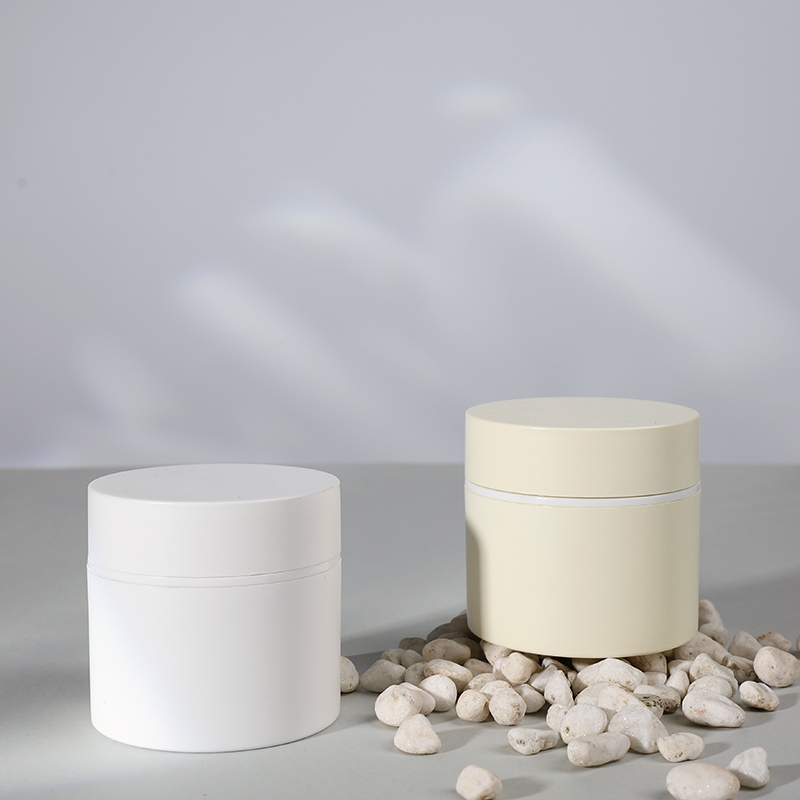
A shopper's hand lingers over a shelf for only a moment, yet that brief contact can redefine the entire product. A jar with a satisfying heft, a lid that turns smoothly and seals with a soft click, or glass with a subtle frost all send signals that go far beyond the label's promises. These tactile and visual details create an unspoken argument: what's inside must be as carefully made as the container itself. Even two jars holding identical contents can be judged differently, because the heavier or better-finished one feels more trustworthy.
Shape plays an equally quiet role. A low, wide-mouth jar suggests abundance and comfort, while a taller, slender profile reads as refined and modern. The choice of label finish matters too—raised lettering or a linen-textured wrap invites touch and implies artisanal care, while a flat, glossy sticker may feel mass-produced. These decisions are not about shouting louder than competitors; they are about giving the jar a voice that murmurs quality rather than announces it.
Color and light complete the illusion of value. Matte coatings or earthy tones can signal natural, small-batch origins, whereas a touch of metallic foil or a deep amber glass hints at luxury and tradition. The way light bends through thick glass or catches a softly embossed logo draws the eye without the need for bright graphics. On a crowded shelf, such restraint often stands out precisely because it does not try too hard—and that confidence is what finally convinces the buyer that the jar holds something worth paying for.
Molding Precision: Inside the Tooling That Shapes Every Jar
The tooling that shapes each jar starts with a level of machining discipline most people never see. Cavity dimensions are held to tolerances tighter than a human hair, often within a few microns, because even a slight drift in the steel translates into visible wall thickness variation or a lid that no longer seats properly. High-speed CNC mills rough out the basic form, then EDM finishing passes burn away any remaining tool marks, leaving a surface that gets polished down to a near-mirror finish. That polish isn't just cosmetic—it directly reduces friction during ejection, cuts down on micro-scratches in the plastic, and helps the jar release cleanly cycle after cycle.
Beyond the cavity itself, the real precision lives in the details most designers overlook. Draft angles are fine-tuned per material, not per guesswork: a high-shrink resin needs a steeper release taper than a low-shrink one, or you'll hear that telltale pop of a part sticking. Cooling channels are drilled to follow the jar's contour rather than laid out in a simple grid, pulling heat away evenly so the lip and base don't warp as they solidify. And the steel choice matters more than people admit—a pre-hardened mold steel can run millions of cycles without losing edge definition, while a cheaper alloy will show pitting and wear at the parting line within a few hundred thousand shots. That difference shows up as a faint seam on the jar or a rim that slowly drifts out of round, which is exactly the kind of flaw that kills a brand's shelf appeal.
Seal the Deal: Engineering Leak-Proof Closures for Thick Creams
Thick creams behave more like soft solids than liquids, so a closure that works for watery lotions often fails here. The product doesn’t just splash against the seal—it clings, settles, and dries into a crust around the orifice. That dried residue is usually what breaks the seal long before the cap does. Designing around this means widening the land area, using a liner with enough compression set resistance to bounce back after repeated openings, and pairing the cap threads so they don’t back off when the jar is tossed in a bag.
Torque matters more than most people admit. Too little and the liner never makes full contact, leaving a slow weep around the rim; too much and the plastic deforms, especially with softer polypropylene caps. For very viscous formulas, adding a plug seal or a crab-claw liner gives a second line of defense. The plug fills the neck even if the outer seal relaxes, and the claw grips the bottle finish to handle side pressure without unthreading.
Temperature swings are the hidden test. A cream that’s filled warm and then shipped cold can pull a vacuum, sucking the liner inward. Venting grooves or a pressure-sensitive liner let the package breathe without letting product escape. After cycling between heat and humidity, the closure should still pass a leak test with the container inverted and squeezed. The goal isn’t just to keep cream in—it’s to make every opening feel the same as the first.
Color Without Compromise: Custom Shades That Keep Their Strength
Matching a brand's exact color often used to mean accepting weaker material performance. But that trade-off no longer applies. By adjusting pigment chemistry and dispersion methods, manufacturers now produce custom shades that hold up just as well as standard options—resisting fading, heat, and mechanical stress without losing their visual identity.
The secret lies in how colorants are integrated into the base polymer or coating. Instead of simply surface-dyeing, high-grade formulations embed stable pigments throughout the matrix, so the hue remains intact even after prolonged outdoor exposure, repeated cleaning, or constant flexing. This approach lets designers specify bold or unusual colors without worrying about premature dulling, chalking, or cracking.
Whether it's a bright safety orange for heavy equipment or a soft pastel for consumer electronics, the final shade stays true to the approved sample batch after batch. Testing includes accelerated weathering, abrasion, and chemical resistance—confirming that the custom color is not just a superficial layer, but an integral part of the material's long-term durability.
From Brief to Batch: What It’s Like to Develop a Jar with Our Team
The first conversation rarely sounds like a design brief. Someone has a half-formed idea—maybe a texture they remember from a childhood kitchen, or a frustration with lids that never seal right. We spend a lot of time just listening, then asking the kinds of questions that make people pause: What should this jar feel like in your hand at 6 a.m.? What sound should the lid make when it closes? Those early talks are deliberately slow, because the brief isn't a document we hand off—it's a shared understanding we keep testing against reality.
Then the prototyping begins, and that's where the team's quirks show up. Our materials specialist will bring in three different glass batches that look identical but behave completely differently under heat. The engineer will obsess over the thread pitch on a lid for an entire afternoon, not because it's in the spec, but because she knows someone will twist it open with wet hands. Meanwhile, someone else is running a drop test on the kitchen counter with a prototype filled with flour, just to see how it fails. It sounds chaotic, but it's actually a kind of deliberate friction—we argue about radii and tolerances until the jar stops being a collection of parts and starts feeling inevitable.
By the time we reach batch production, the jar has been through more hands than most products ever see. There's a moment when the first sample comes off the line and everyone gathers around, not to check it against a checklist, but to see if it still feels like the thing we talked about months ago. Usually it does, with small surprises—a slightly warmer tone in the glass, a smoother glide on the thread. Those surprises aren't mistakes; they're the residue of all those decisions made together. And that's what developing a jar with us actually is: a long, occasionally messy conversation that ends with an object you'll use every day without thinking twice.
FAQ
PP stands up well to frequent handling. It resists cracking, holds its shape in humid bathroom environments, and won't react with most cream bases or mild acids. The jars stay lightweight without feeling flimsy, which keeps shipping costs down while still protecting the product.
Yes. We can match specific brand colors using masterbatch, and the surface can be glossy, matte, or coated with a soft-touch layer. Frosted effects are also available by adjusting the mold texture. A pre-production sample is always sent so you can approve the exact look before full molding.
The range covers jars from 5 ml up to 200 ml. Common profiles include low wide-mouth jars for balms, tall slim jars for serums, and double-wall designs that add a heavier feel. Thread depths and shoulder styles can be tailored, so the same lid can work across several jar sizes in a line.
We run drop tests on filled samples from three angles and check lid torque after vibration testing. Inner liners or induction seals are offered for liquid-heavy creams. The bottle neck and thread are molded to a tolerance of ±0.1 mm, so the lid stays tight without over-tightening.
Polypropylene is generally inert with common actives like vitamin C derivatives, niacinamide, and salicylic acid at typical pH levels. If your formula contains essential oils or solvents, we can test the specific blend with the jar and seal material before finalizing the order.
For stock shapes with custom printing, the MOQ can start around 5,000 pieces. If you need a completely new mold, it usually starts at 20,000 pieces because the mold cost is amortized into the unit price. Exact numbers depend on jar weight and decoration, so it's best to share your target volume first.
Yes, lids are included in the quote unless you want to source them separately. We offer PP, ABS, and bamboo-look overcap options. For inner seals, PE foam liners and induction seals are available, and we can pre-insert them so your filling line doesn't need an extra step.
Each shift pulls samples from the molding machine for dimensional checks, weight measurement, and visual inspection. We also do a random seal integrity test on finished jars every two hours. If any batch falls outside the agreed tolerance, that whole lot is held for review rather than shipped.
Conclusion
Durability in a PP cream jar starts long before the first batch leaves the line. It comes from a careful blend of polypropylene grades that resist cracking under temperature swings and rough handling, yet still let us keep walls thin enough to feel substantial without being heavy. That same material discipline carries into the tooling, where every cavity is CNC-machined and polished to a tolerance that hides parting lines and keeps threads consistent. The result is a jar that clicks shut with a satisfying certainty, and a surface that catches light cleanly on the shelf. Buyers often decide quality with their hands first; a well-molded rim and a flat, stable base do more for perceived value than any label claim.
Beyond the shell, leak-proof closures are engineered for thick creams—wide-mouth openings and a sealing bead on the inner cap prevent messy seepage, even after repeated opening. Color choices are not just about trend; pigments are selected to hold their tone through UV exposure and frequent cleaning, so a custom shade stays true from prototype to final production. Developing a new jar with our team moves from a rough brief to a pilot batch through shared 3D models and physical samples, so you see and feel every change before it is locked. It is that mix of tooling precision, material honesty, and design restraint that turns a simple container into a durable, stylish brand asset.
Contact Us
Contact Person: Kara Yang
Email: [email protected]
Tel/WhatsApp: 8618857568397
Website: https://www.haitongplastic.com/