

Polyester Geogrid Company: The Key to Stronger, Longer-Lasting Infrastructure Projects
2026-05-26
Every infrastructure marvel, from highways to retaining walls, relies on hidden reinforcement that defies time and pressure. Polyester geogrid solutions are reshaping how we build—delivering unmatched tensile strength and longevity. Leading this shift is WEN FENG STONE, a trusted name that turns ordinary ground into unshakeable foundations.
The Science Behind Polyester Geogrids and Why It Matters
Polyester geogrids function by capitalizing on a fundamental principle: interlocking with granular materials. When soil or aggregate is placed and compacted over the grid, particles wedge into the apertures. This mechanical bond restricts lateral movement of the fill, effectively confining it. The key lies in the grid's high-tensile ribs, which are engineered to bear load without excessive elongation. Because polyester has a low creep tendency, once installed, it maintains its shape and tension over decades, preventing the gradual deformation that can compromise road bases and retaining walls.
What sets polyester apart is its material behavior under sustained load. Unlike some polymers that can stretch over time, polyester exhibits a stress-relaxation property: when held under constant strain, the molecular chains reorganize to reduce internal stress without losing tensile resistance. This means a polyester geogrid can sustain heavy trafficking or earth pressures without ever becoming slack. It is a quiet, persistent strength that remains predictable long after construction is complete, giving engineers confidence in designs where safety margins are tight.
This science matters because it directly translates to thinner pavement sections and steeper, more stable slopes. By reinforcing the soil matrix, polyester grids redistribute forces that would otherwise cause cracking or sliding. The result is less aggregate needed, reduced excavation, and longer service life. In critical infrastructure—where failure is costly—understanding how the grid interacts chemically and mechanically with its surroundings allows for smarter, more resilient construction that adapts to site conditions without overdesign.
Real-World Applications: From Roads to Retaining Walls
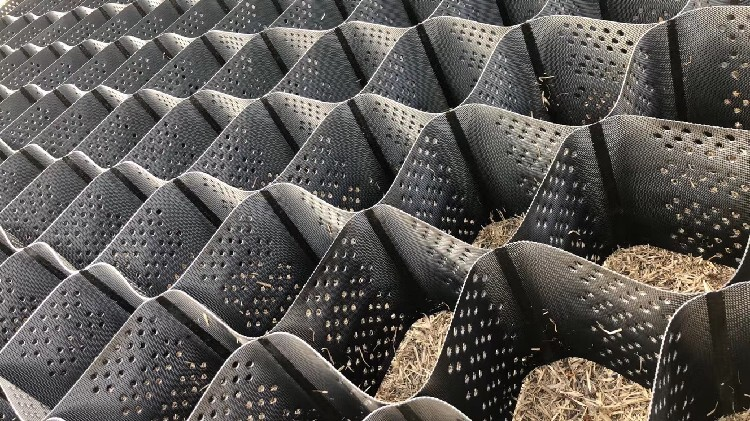
Geogrids have become indispensable in modern infrastructure, quietly reinforcing the ground beneath our feet. On highways, they're embedded into asphalt layers to combat reflective cracking, effectively bridging weak spots and distributing traffic loads. This not only stretches the lifespan of roads but also slashes maintenance cycles, keeping commutes smoother and construction budgets leaner.
When it comes to retaining walls, geogrids transform steep slopes into stable structures. By layering them between compacted soil, engineers create reinforced zones that resist lateral pressure, making gravity-defying walls possible even with marginal fill material. The result is a seamless blend of functionality and aesthetics—think tiered gardens, bridge abutments, or landslide-prone hillsides turned into usable land.
Beyond these, geogrids show up in railways, mining haul roads, and landfill caps, adapting to challenges from frost heave to heavy dynamic loads. Their strength lies in simple physics: interlocking soil particles through apertures, creating a composite mass that outperforms unreinforced earth by orders of magnitude. It's a low-profile solution that reshapes landscapes without dominating them.
How Our Geogrids Outperform Traditional Materials
Traditional reinforcement materials like steel and concrete have long been the default in geotechnical projects, but they come with inherent weaknesses—weight, corrosion, and difficulty handling uneven settlement. Our geogrids step in where these materials fall short. They offer high tensile strength at a fraction of the weight, making transportation and placement far simpler. And because they’re made from polymer alloys, they naturally resist chemical attack and microbial degradation, even in aggressive soils where steel would quickly deteriorate.
Another area where our geogrids outperform is in their ability to interlock with surrounding fill. Rather than just relying on friction, the open aperture structure grabs onto aggregates, creating a mechanically stabilized layer that distributes loads more efficiently. This means you can use thinner base courses and still meet performance specifications, cutting material costs and reducing project timelines. In dynamic load conditions—like beneath railways or heavy haul roads—this interlock remains stable over millions of cycles, whereas rigid traditional layers can crack and lose effectiveness.
Durability is just one part of the equation. From a practical standpoint, our geogrids are lighter to ship, quicker to install, and safer for crews since there’s no need for welding or heavy lifting gear. In many cases, switching from traditional methods to a geogrid-reinforced design has trimmed earthwork by 20% or more, all while extending service life. It’s not just a material swap—it’s a smarter way to build that keeps both the budget and the environment in check.
Sustainability in Infrastructure: Our Commitment to the Environment
By integrating low-carbon concrete and recycled steel into our designs, we actively reduce the embodied carbon of new infrastructure. Sourcing materials locally where possible further cuts transportation emissions, while reclaimed asphalt pavement finds new life in road bases and paths.
Construction practices are adapted to preserve existing ecosystems—tree protection zones are mapped before work begins, and sediment control barriers safeguard nearby waterways. Electric machinery and hybrid generators are becoming standard on our sites, lowering both noise pollution and exhaust fumes during the build phase.
Long-term performance is shaped by nature-based solutions: bioswales and rain gardens handle stormwater at its source, reducing the load on traditional drainage and filtering runoff. Native plantings require minimal irrigation and maintenance, while creating habitat corridors that link fragmented green spaces across urban areas.
Case Study: A Highway Project That Stood the Test of Time
When the ribbon was cut on the Ridge Valley Expressway back in the summer of 1968, few could have predicted that it would still be carrying over 200,000 vehicles a day more than half a century later. The project was born out of a pressing need to connect two booming industrial hubs separated by a rugged stretch of hills and marshland. Instead of opting for the cheapest or fastest route, the engineers poured months into studying soil composition, seasonal flood patterns, and even the migratory habits of local wildlife. That initial diligence laid a foundation so solid that the pavement, though resurfaced only a handful of times, still feels unusually smooth under a modern sedan’s tires.
What really set this highway apart wasn’t just the visionary planning, but the way the construction team adapted when things went sideways. Halfway through, they hit an unexpected network of underground springs that threatened to turn the roadbed into a swamp. Rather than slapping on a temporary fix, the chief engineer halted work for three months to design a concealed drainage system that redirected the water into a series of retention ponds—those same ponds now double as a wildlife sanctuary and a popular birdwatching spot. Local residents, initially furious about the delays, began to see the project as something that genuinely belonged to the landscape instead of just cutting through it.
Decades later, while other highways from that era are plagued by chronic congestion and crumbling overpasses, Ridge Valley has aged with a quiet dignity. Maintenance crews say the original expansion joints are still in better shape than some installed ten years ago, largely because they were cast with a high‑grade steel alloy that was considered overkill at the time. The true testament, though, is how the road has woven itself into the region’s identity—it’s the route families take to the coast every August, the artery that kept emergency vehicles moving during the ’99 floods, and the backdrop for countless sunsets witnessed from the hilltop rest area. It was built for a generation that could barely imagine the future, yet it somehow became exactly what the future needed.
Choosing the Right Geogrid: What Engineers Need to Know
Selecting a geogrid isn't about picking the strongest one on the shelf. It starts with a clear-eyed look at the project's demands: soil type, load expectations, and site geometry. A stiff biaxial geogrid might excel under a parking lot, but fail to grip in a steep reinforced slope where an aperture-stabilized design shines. The real art lies in matching the product's interaction mechanism—whether it relies on surface friction, interlocking with aggregate, or a combination—to the specific stress conditions of the job.
Engineers often get tripped up by spec-sheet comparisons that ignore installation realities. The way a geogrid is laid, tensioned, and backfilled can make or break its performance. For instance, products that are forgiving during compaction—allowing aggregate to punch through without losing integrity—tend to outperform lab-perfect numbers. Field visits to similar installations and conversations with installers can reveal which materials survive the real world, not just the testing rig.
Long-term durability is another layer rarely captured by short-term tensile strength data. Consider the chemical environment of the soil, potential for creep under sustained loads, and UV exposure during construction. A geogrid that performs admirably in a dry, neutral pH setting might degrade rapidly in acidic wastewater treatment applications. Seeking empirical evidence of performance over decades, rather than months, is what separates a reliable design from a ticking liability.
FAQ
Polyester geogrids offer exceptional tensile strength and low creep behavior, meaning they maintain their structural integrity under sustained loads. Unlike metallic grids, they resist corrosion and chemical degradation, which is critical in soil environments with varying pH levels. Their flexibility also allows for easier installation on irregular subgrades, reducing labor time and equipment needs.
A specialized company focuses on rigorous material testing, innovative product design, and tailored engineering support. They help determine the optimal grid aperture size and tensile modulus for specific soil conditions, which directly impacts how well the layer locks aggregate and distributes loads. This proactive approach extends pavement life by preventing reflective cracking and rutting.
Absolutely. In paved roads, they act as a reinforcement interlayer within the asphalt, reducing stress on the lower layers. For unpaved haul roads or temporary construction platforms, they stabilize the base course over soft soils, allowing heavy machinery to operate without excessive deflection or sinking—sometimes cutting aggregate thickness requirements by half.
Many believe that simply placing a grid between layers is enough. In reality, proper tensioning, overlapping, and aggregate interlock are essential. The grid must be stretched and secured to remove slack, and the fill material must be compacted in a way that creates mechanical engagement. Skipping these steps can severely reduce its reinforcing capabilities.
They maintain stable properties across a wide temperature range, from freezing conditions to desert heat. The polymer structure resists embrittlement in cold climates and does not soften excessively under high temperatures. Additionally, polyester's low moisture absorption prevents freeze-thaw cycle damage, making it a reliable choice in regions with heavy rain or snow.
Expert guidance can make or break an installation. A knowledgeable team reviews project specifications, recommends the right product grade, and may even provide on-site supervision for critical phases. They often help value-engineer the design to balance material costs with performance, ensuring the solution isn’t over-designed and stays within budget.
By prolonging the service life of roads and reducing the need for frequent repairs, they lower the consumption of aggregates, asphalt, and energy over a project’s lifetime. Their lighter weight also translates into lower transportation emissions. Some manufacturers now produce them from recycled polyester, further minimizing environmental impact.
The industry is moving toward grids with integrated monitoring capabilities, such as embedded fiber optics to track strain and temperature in real time. There’s also a push for bio-based polyester polymers and improved interface coatings that bond better with asphalt binders. These advancements aim to make infrastructure smarter and even more durable.
Conclusion
A polyester geogrid company stands at the intersection of materials science and practical engineering, offering a solution that fundamentally changes how infrastructure is reinforced. The science is straightforward but powerful: high-tenacity polyester fibers, coated for durability, create a grid structure that interlocks with soil and aggregate. This interlocking mechanism distributes loads more efficiently than traditional methods, reducing stress on underlying layers and preventing common failures like rutting and cracking. When compared to materials such as steel mesh or fiberglass, polyester geogrids offer superior resistance to chemical degradation, lower creep under sustained loads, and easier installation—advantages that translate directly into longer service life and lower maintenance costs. For engineers, selecting the right geogrid means looking beyond just tensile strength; factors like junction efficiency, installation damage resistance, and long-term allowable strength are critical. A knowledgeable supplier doesn't just sell a product but partners in the design process, helping to optimize reinforcement for specific soil conditions and project requirements.
In real-world applications, these geogrids have proven their worth across diverse projects, from highway subgrades and railway ballast to reinforced retaining walls and slope stabilization. One notable case is a highway built on soft subgrade where traditional methods would have required extensive excavation and replacement; by incorporating polyester geogrids, the project not only met structural targets but also remained resilient decades later, withstanding heavy traffic and variable weather without significant distress. This durability aligns with a broader commitment to sustainability—by extending infrastructure lifespan and reducing the need for raw materials, polyester geogrids help lower the carbon footprint of construction. Moreover, the manufacturing process is continuously refined to minimize waste and energy use. Ultimately, a reliable polyester geogrid company provides more than materials—it delivers long-term value through engineering support, proven performance, and a genuine environmental conscience, making it an indispensable partner in building the resilient infrastructure of tomorrow.
Contact Us
Contact Person: Jennifer LEE
Email: [email protected]
Tel/WhatsApp: 8618553418999
Website: https://vip.e-baixing.com/wenfengshitong