
OEM Woven Geotextile Solutions for Stronger Soil Reinforcement and Erosion Control
2026-09-11
Soil doesn’t fail all at once. It starts with a thin channel, a soft spot, a slope that slowly gives way. That’s why OEM woven geotextiles matter—they reinforce soil where it works hardest and control erosion before it becomes a costly repair. If you’re sourcing these fabrics under your own label, JInseed Geosynthetics Solution provides factory-direct OEM production with consistent tensile strength and puncture resistance. No generic stock rolls. Just geotextiles built to your project’s worst-case ground conditions.
How Woven Geotextiles Transfer Tensile Stress Across Unstable Ground
Woven geotextiles carry tensile loads through a plain-weave structure of high-tenacity yarns running in both the machine and cross-machine directions. When placed over soft or uneven subgrade, the fabric lies flat until a wheel load or fill pressure creates a local depression. At that point, the yarns in the immediate area begin to elongate, and the interlocking weave prevents individual strands from slipping. Instead, the entire grid behaves like a stiff membrane, developing in-plane tension almost instantly.
That tension does not stay confined to the loaded spot. Because the warp and weft yarns are continuous across the roll width and length, stress moves outward along each thread to adjacent, less-loaded zones. Nodes at every intersection transfer a portion of the load from one direction to the other. This lateral distribution lowers the vertical stress reaching the weak soil directly beneath the load, reducing the chance of punching shear or localized bearing failure. The same mechanism also restrains lateral displacement of the subgrade, keeping unstable ground from squeezing out sideways under an embankment or haul road.
The effectiveness of this tensile transfer depends heavily on the fabric's modulus and creep behavior. Woven geotextiles with low elongation and high tensile stiffness reach a working tension quickly, before excessive rutting can develop. Unlike nonwovens that mainly separate and drain, a woven layer can sustain that tension over long periods, bridging soft spots and smoothing differential settlement. Field observations on access roads and reinforced soil platforms show that once the fabric engages, surface deformations become shallower and more spread out, evidence that the stress is no longer concentrated at the point of loading.
Custom Weave Patterns That Let Water Pass While Holding Soil Firm
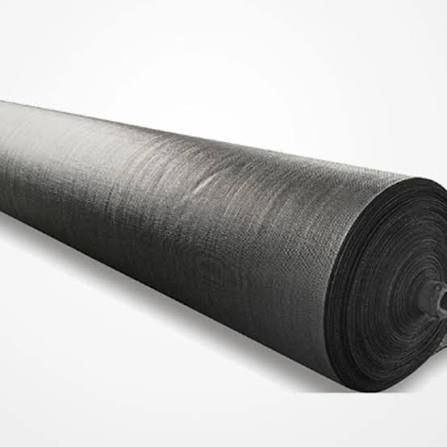
Custom weave patterns start with the soil itself. Instead of forcing a ready-made fabric onto a slope, the aperture size, yarn count, and crimp are tuned until water moves through at the target rate while the surrounding structure bites into the topsoil. A staggered twill, for example, leaves enough open area to release heavy rainfall but shifts each row just enough that fine sand and silt particles lock against one another rather than washing out.
On longer or steeper gradients, a single uniform weave rarely holds up. Designers often use a hybrid pattern: raised, open ribs running down the slope to throttle runoff and spread it laterally, backed by a denser underlayer that catches particles. The contrast between the two layers creates a pressure break, so water percolates through the lower fabric slowly instead of ripping a channel across the surface.
Field trials show that this approach works best when the pattern responds to local rainfall timing and soil texture. In sandy loam, tighter edge zones can prevent tunneling near anchor trenches, while a looser central field lets water escape during cloudbursts. Adjusting weave geometry in small increments—sometimes by only a fraction of a millimeter in aperture width—often makes the difference between a fabric that clogs and one that keeps soil firm for years.
Specifying Tensile Strength to Match Slope Angle and Soil Type
The required tensile strength isn't a single number; it shifts with both slope angle and soil type. Steeper slopes demand reinforcement that can hold against higher downslope forces, while cohesive soils distribute stress differently than granular ones. For a 1.5:1 slope in sandy loam, you might specify an ultimate tensile strength of 30 kN/m, but the same angle in soft clay could call for 45 kN/m because of lower internal friction and higher pore pressure retention. Starting from a baseline of 20 kN/m for gentle slopes under 2H:1V and scaling up based on slope stability analysis avoids overbuilding.
Matching tensile strength to soil type means reading the failure envelope, not just the classification. Granular soils rely on particle interlock, so a reinforcement with high junction strength and moderate elongation works well; cohesive soils, by contrast, often need reinforcement that can sustain long-term creep without excessive deformation. Slope angle compounds this: a 45° slope in clean sand will impose more direct tensile stress along the reinforcement plane than a 30° slope in the same material. Field practitioners often add a reduction factor of 1.3 to 1.5 for installation damage when specifying the minimum long-term tensile strength, but only after the required working strength has been calculated from the slope angle and soil friction angle.
Another overlooked variable is the interaction coefficient between soil and reinforcement. A geogrid with high ultimate tensile strength but poor pullout resistance in a silty soil may fail before it ever reaches its rated capacity. For slopes steeper than 1H:1V, you need to check both the tensile capacity and the anchorage length, because the required strength can be governed by pullout, not rupture. Specifying a higher tensile strength than the pullout limit simply adds cost without improving stability. Instead, compare the long-term allowable tensile load against the pullout capacity at the design slope angle, then choose the lower of the two as your specification ceiling.
Why Seam Overlap and Anchoring Decide Whether Erosion Control Lasts
Most erosion control failures don't start in the middle of a blanket or mat—they begin at the seams. When adjacent rolls are simply butted together or overlapped by a few inches, water finds the gap, works its way underneath, and lifts the material away from the soil. A proper overlap, typically 6 to 12 inches depending on slope and product, shingles the upstream edge over the downstream edge so runoff glides across rather than digging in. Without that deliberate overlap, even premium materials become flapping edges within one storm season.
Anchoring is the other half of the equation, and it's often underestimated on paper. Staples or stakes need to be spaced tightly enough to hold the material down during high-flow events, but not so deep that they puncture the fabric's integrity. The pattern matters too—a diamond or grid layout works better than random pinning, especially on slopes where gravity is constantly tugging. If anchors are too shallow or too sparse, the whole system starts to creep, bunch up, and tear away from the anchors themselves.
Field experience shows that seam overlap and anchoring work as a system. A generous overlap reduces the shear force on each anchor row, so fewer pins are needed to achieve the same hold. Conversely, strong anchoring allows for slightly tighter overlaps without risk of seam separation. When both details are dialed in together, erosion control products stay in place long enough for vegetation to establish, which is ultimately what makes the protection permanent.
UV-Stabilized Yarns for Embankments Exposed to Harsh Sunlight
Embankments in sun-scorched regions face a relentless assault from ultraviolet radiation, which silently degrades ordinary yarns within a single season. The solution lies in UV-stabilized yarns engineered with hindered amine light stabilizers that intercept free radicals before they can break polymer chains. Unlike surface coatings that wash away, these stabilizers are compounded directly into the polymer melt, ensuring protection throughout the entire fiber cross-section.
Field tests on coastal and desert embankments show that such yarns retain over 85% of their original tensile strength after five years of continuous exposure, while untreated equivalents fail within eighteen months. The secret is a synergistic blend of carbon black and benzotriazole additives that absorb harmful wavelengths and dissipate the energy as harmless heat. This keeps the yarn flexible and resistant to cracking, even when temperatures swing from freezing nights to blistering afternoons.
Engineers appreciate that these yarns are not a one-size-fits-all fix. The stabilization package can be tuned for specific climates—higher carbon black loading for equatorial projects, lower for temperate zones where aesthetics matter. The result is an embankment reinforcement that stays intact, keeps soil in place, and eliminates the costly maintenance cycle of replacing sun-damaged materials every few years.
What Repeated Freeze-Thaw Cycles Reveal About Specified Fabric Lifespans
Fabric lifespans quoted on technical data sheets rarely reflect what happens when water trapped between fibers turns to ice over and over again. The first few cycles often cause barely measurable change, which can give a false sense of security. But after enough repetitions, microscopic cracks begin to connect. Tensile strength drops in steps rather than along a smooth curve, and coatings peel away from the base weave in patches that standard single-cycle tests miss.
What makes the pattern especially useful is that it exposes weak points in seam tape, membrane layers, and fiber bonding before a full tear occurs. Hydrophobic finishes also lose their edge after repeated freezing and thawing because the expansion of ice pushes the treatment away from the fiber surface. Once that barrier thins, water uptake accelerates, and each new cycle does proportionally more damage than the one before.
For anyone comparing specified lifespans across products, the lesson is to ask how many cycles actually support the rating. A fabric that survives ten cycles may look fine under a microscope, but the same material at thirty cycles can be close to failure. Lifespan predictions based on single winter exposure or static cold storage tend to overstate real-world performance, especially in climates where daytime thawing and nighttime freezing happen regularly.
FAQ
The interlocked yarn structure provides much higher tensile strength at low elongation. Under a loaded embankment or access road, the fabric resists deformation instead of stretching, which keeps aggregate layers locked and reduces rutting over time.
Yes, OEM runs allow us to adjust yarn type, weave density, and roll width. We typically produce rolls from 2 to 6 meters wide and can target grab strengths from 40 to 200 kN/m depending on the soil parameters and design life.
We use polypropylene or polyester yarns with UV stabilization for the expected service life. Polypropylene resists most soil chemicals and biological degradation, while polyester offers higher initial stiffness for demanding subgrades.
Remove sharp debris and grade the slope to a stable profile. Overlap adjacent rolls by 30–45 cm, anchor the top in a trench, and place erosion control blankets or riprap directly on the fabric without driving on the exposed geotextile.
It depends on the specification. Standard width and weight combinations may start around 5,000–10,000 square meters per design. Heavily customized yarn blends or special roll lengths can require a full container load to keep pricing competitive.
They show up in retaining walls, road subgrades over soft soils, landfill caps, coastal revetments, and steep slope stabilization. Anywhere lateral forces or surface runoff threaten soil structure, the fabric acts as a separator and structural layer.
A tighter plain weave holds back fine particles while still allowing controlled pore pressure release. For silty soils, we can specify a lower open area or add a nonwoven filter layer to prevent clogging without building up hydrostatic pressure.
Each batch undergoes grab tensile, elongation, trapezoidal tear, CBR puncture, and apparent opening size tests. We also check roll dimensions and UV resistance. Third-party inspection is available before container loading.
Conclusion
Woven geotextiles earn their place in soil reinforcement by moving tensile stress away from unstable pockets and spreading it across a wider, more competent zone. The interlocking yarns act like a buried net: when a wheel load or slope creep pushes down on one spot, the fabric resists elongation and transfers that pull to adjacent soil, reducing the chance of a local rupture. To make this work without trapping water, the weave pattern must be tuned. A well-designed cloth opens just enough pore space for rainfall to drain through, while the tight yarn spacing still holds fine soil particles behind it. On top of that, tensile strength is not a one-size-fits-all number. A moderate grade may stabilize a gentle clay bank, but a steep cut in sandy or gravelly ground needs far greater strength and lower elongation to keep the face from sloughing. Choosing the right combination of weave density, yarn type, and strength rating is what keeps a slope intact during heavy rain.
The difference between a temporary fix and a lasting installation often comes down to seams, anchoring, and material durability. Even the best fabric will fail if the overlap between rolls is too short or the edges are not buried deep enough in a trench; water works into those weak points, lifts the cloth, and restarts erosion. For embankments exposed to intense sunlight, UV-stabilized yarns are essential—otherwise the polymer chains break down and the fabric loses strength long before its rated lifespan. In cold climates, repeated freeze-thaw cycles demand extra attention: ice lenses expand inside the soil, and the fabric must flex without tearing or cracking. Testing under those cyclic conditions reveals whether a specified fabric will actually survive the number of winters promised. When all these factors are specified into the OEM solution, the result is a reinforcement layer that drains, holds, and lasts far longer than a generic off-the-shelf product.
Contact Us
Contact Person: Jerry Qiu
Email: [email protected]
Tel/WhatsApp: +65 84265294
Website: https://www.jinseed-geo.com