

MCCB Manufacturer Delivering Dependable Molded Case Circuit Breakers for Modern Power Systems
2026-11-02
Modern power systems demand more than just components—they need robust protection that keeps operations running without interruption. As a leading MCCB manufacturer, ETEK delivers dependable molded case circuit breakers engineered to handle the complexities of today's electrical networks. In this post, we explore what makes these devices essential for safe, efficient power distribution.
When a Fault Hits, Every Millisecond Counts
In a live production line, a tiny voltage dip can trigger a chain reaction before anyone even glances at the monitor. The gap between fault detection and corrective action isn't measured in seconds—it's measured in the time it takes for a relay to open, a breaker to trip, or a controller to log the event. Experienced engineers know that a well-tuned protection scheme doesn't just isolate the problem; it preserves the surrounding process, keeping downstream equipment from riding the same fault wave.
Consider a packaging plant where a single motor winding begins to arc. If the system waits for thermal overload confirmation, the damage multiplies across the gearbox, coupling, and even the feeder control. But a relay set to catch the first signature of abnormal current—within a few cycles—can drop that motor offline before the rotor locks. That's not conservative design; that's understanding that every millisecond of fault duration carries a cost, whether it's burnt insulation, sheared pins, or a cascade that shuts down an entire shift.
The difference often comes down to settings that many technicians still treat as an afterthought. Time-delay curves, instantaneous trip thresholds, and zone coordination aren't just paperwork for arc-flash studies. They are the practical difference between a ten-minute reset and a ten-hour rebuild. When a fault hits, your protection is either ahead of the damage curve or chasing it.
Molded Cases Engineered for Harsh, Confined Spaces
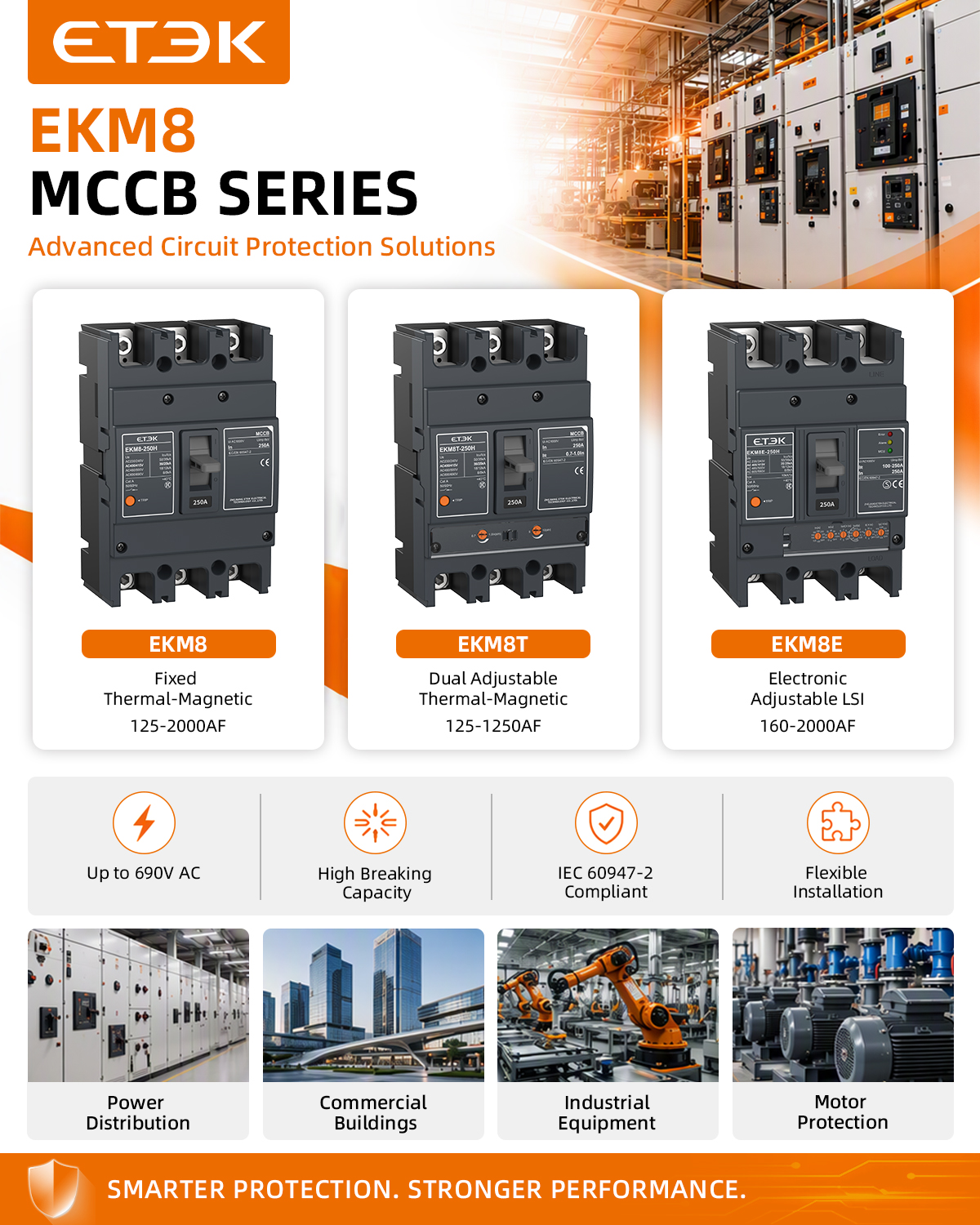
Think about the last time you had to route cabling through a bulkhead with barely enough room for your hand, let alone a standard enclosure. That's where these molded cases earn their keep. The body geometry is pared down to the absolute minimum, with no unnecessary flanges or protruding bosses, so they slip into tight racks, under dashboards, or beside moving machine parts without forcing you to redesign the surrounding assembly.
The material isn't just a generic ABS blend. We spec a high-impact, chemical-resistant polymer that shrugs off oil mist, salt spray, and the occasional dropped wrench. Corner radii and wall thicknesses vary across the shell, not uniformly, which means impact energy gets absorbed where it actually hits instead of cracking at the thinnest section. Sealing surfaces are recessed to protect the gasket from abrasion when the case is dragged across a concrete floor during installation.
Fastening points are countersunk and strategically relocated inward, so a protruding screw head never becomes the reason a panel won't close. Vents, if needed, are molded as labyrinth channels rather than punched holes, keeping out dust while still allowing pressure equalization. Every surface that an installer's knuckles will scrape against has been radiused, because a case that survives the environment shouldn't draw blood from the person putting it in.
Trip Settings That Match Your Equipment, Not a Template
Most trip settings start from a generic preset, then force your gear to fit. That's backwards. Your equipment has a specific weight, balance, and response curve—so why would a one-size-fits-all profile ever feel right? Instead of scrolling through endless preloaded modes, think about what actually changes when you mount a different lens, swap to a heavier battery, or add a cage. The settings shouldn't be a starting point you tweak endlessly; they should be built around the physical reality of what's in your hands.
A lightweight handheld rig behaves nothing like a fully loaded shoulder setup. The moment you change the center of gravity, the same pan and tilt speeds feel either sluggish or twitchy. That's why matching settings to equipment means measuring the rig first—know the total weight, the distance from the grip to the sensor, and the torque needed to hold a frame steady. Then adjust acceleration and deadband accordingly. It's less about finding a magical number and more about listening to how the motors respond when you move naturally.
The real advantage comes when you stop chasing templates altogether. Build a baseline for each individual setup you own, save it under a name that makes sense to you—not "Mode 3"—and refine it only when something physically changes. Swap a prime for a zoom? Recalibrate. Add a follow focus? Rebalance and retest. This approach takes a bit more time up front, but the result is a rig that feels like an extension of your arm rather than a device fighting against your instincts.
One Standard of Care from Assembly Line to Substation
At the assembly line, torque values, insulation clearances, and surface finishes are checked with the same rigor applied to final factory tests.
That same discipline follows each unit through crating, transport, and installation at the substation, where on-site measurements are compared against factory baselines.
By refusing to treat field work as a separate, lower tier of quality, the team keeps warranty claims rare and energization delays even rarer.
Why Thermal Stability Matters More Than Breaking Ratings Alone
A breaking rating tells you how much force a line or cable can take in a controlled, room-temperature test. But that number means very little once the material gets hot. Leave a high-strength line on a sun-scorched boat deck or inside a closed car in summer, and its actual breaking point can drop sharply. The molecules in many polymers begin to soften, realign, or even degrade long before the material shows visible damage. So a line rated for 60 pounds at 70°F might fail at half that load after a few hours of direct heat.
Thermal stability reflects how well the material keeps its structure and load-bearing ability as temperature rises. It is not just about melting; many synthetics lose a large share of their strength well below the melting point. Repeated heating and cooling cycles can also cause micro-cracks or changes in flexibility, making the line more likely to snap under sudden strain. A product with a lower nominal breaking rating but excellent heat tolerance will often outperform a higher-rated product that weakens quickly in real conditions.
That is why you should look beyond the single breaking rating printed on the label. Ask whether the manufacturer tests strength at elevated temperatures, and check what happens after prolonged heat exposure. A line that maintains most of its rated capacity across a wide temperature range gives you more predictable performance when it matters — whether you are fishing from hot rocks, working near engine compartments, or leaving gear stored in a warm shed.
Support That Arrives Before You Need a Replacement
Most support teams only show up after something breaks. Ours works differently. From the first week, you get a dedicated specialist who learns your setup, your usage patterns, and the quirks of your environment. That way, when performance dips or a part starts wearing early, we often spot it before you do—and reach out with a plan instead of waiting for a failure ticket.
This proactive approach means fewer urgent calls and more predictable operations. You won’t need to explain your entire system to a stranger at 2 a.m. Instead, you’ll have a running conversation with someone who already knows the history. If a replacement is ever truly needed, the groundwork is already done: the right model, the right firmware, and the right install window are confirmed in advance.
The real difference is timing. By the time you’d normally start researching a fix, we’ve already staged the solution. That keeps your focus on the work that matters, not on managing a parts emergency. And when the moment does come to swap a component, it feels less like a rescue and more like a scheduled upgrade.
FAQ
We subject every design to thermal cycling, vibration, and humidity tests that exceed standard requirements. Components are sourced from certified suppliers, and each unit goes through a final endurance check before shipping. The trip units are calibrated individually, not sampled, so the performance curve holds across the entire production run.
An MCCB combines overload, short-circuit, and often ground-fault protection in one compact enclosure. Unlike fuses, it can be reset after a trip. The molded case provides insulation and mechanical strength, making it suitable for distribution boards and industrial control panels where space is tight but reliability cannot be compromised.
Yes. We offer adjustable thermal-magnetic and electronic trip units that can be tuned to handle inrush currents from inverters and variable-speed drives. Our breakers maintain a stable trip response even when the supply frequency or voltage swings, which is common in solar and wind applications.
We keep a technical team available for selection guidance, coordination studies, and on-site troubleshooting. Spare parts remain in stock for at least ten years after a series is discontinued. If a breaker trips unexpectedly, our engineers can analyze the trip curve data to identify whether the issue is load-related or a genuine fault.
Each frame size is tested in a high-power laboratory under controlled fault conditions. We measure the let-through energy and peak current, then compare them against the published ratings. Only after three consecutive successful interruptions at the rated breaking capacity does a design receive approval for mass production.
Our products carry UL, IEC, and CCC certifications depending on the target market. We also follow RoHS and REACH directives for environmentally sensitive components. Compliance is not treated as a one-time event; regular factory audits and third-party testing keep the certifications valid.
Several of our MCCB series support auxiliary contacts, shunt trips, and communication modules that connect to building management systems. You can read breaker status, trip events, and load current remotely through Modbus or digital I/O. This helps utility and facility managers respond faster to faults without walking the panel.
We start with the system voltage, available fault current, and load profile. Then we narrow down frame size, trip rating, and breaking capacity. If the application involves motors or transformers, we consider starting currents and inrush. Our selection charts and online tools simplify this, but a direct conversation with our application engineers usually catches details that generic tools miss.
Conclusion
When a short circuit tears through a modern power system, the difference between a contained event and cascading damage often comes down to how a breaker reacts in those first milliseconds. This manufacturer builds molded case circuit breakers around that reality—not around catalog specs alone. The cases are shaped for tight compartments and harsh environments where heat, dust, and vibration would punish ordinary equipment. Instead of forcing engineers to adapt their protection scheme to a fixed product, each unit's trip settings are matched to the actual load profile, inrush characteristics, and fault levels of the connected equipment. That kind of customization removes the usual compromise between sensitivity and nuisance tripping.
Consistency matters just as much as clever design. From the first component placed on the assembly line to the final witness test in a substation, the same inspection thresholds and torque values are applied—so a unit shipped this year behaves like one built five years ago. The company also treats thermal stability as a primary design target, recognizing that sustained temperature rise under load can degrade contacts and insulation long before a breaker ever approaches its interrupting rating. And when something does go wrong, support engineers tend to show up with test data and replacement strategy already in hand, not after days of back-and-forth. That preemptive support is what separates a dependable supplier from a transactional one.
Contact Us
Contact Person: Andy
Email: [email protected]
Tel/WhatsApp: +86 13356133008
Website: https://www.etek-china.com/