

Knee Massager Factory Standards That Ensure Safe and Effective Devices
2026-11-29
Not every knee massager earns a place in your recovery routine. Behind the sleek exteriors and promising specs, factory standards quietly decide whether a device truly protects your joints or just vibrates them. From material purity and pressure calibration to overheating safeguards, the difference between a safe companion and a risky gadget is built long before it reaches your hands. At XINGBU, those standards aren’t an afterthought—they’re the blueprint. Here’s what to look for before your next purchase, and why factory-level quality control matters more than any marketing claim.
When a Knee Massager Leaves the Floor, These Checks Already Happened
Before a knee massager ever gets boxed up, it goes through a quiet round of small tests that most people never see. The first check is purely mechanical: every hinge, strap, and pressure point gets worked back and forth dozens of times to catch any weak seam or loose connection before it leaves the factory floor. If a buckle slips even once during that cycle, the unit doesn't move forward until the issue is traced and fixed.
Next comes the heat and vibration run. The device is switched on at full intensity for longer than any normal session would last, while someone monitors the surface temperature at several points. This isn't about chasing a spec sheet number—it's about making sure the warmth stays comfortable against bare skin and never drifts into a range that could cause redness or irritation. Vibration motors are also checked for stable output, because a unit that feels smooth on day one shouldn't turn buzzy or uneven by day ten.
The final step is a real-use pass with human hands and knees of different sizes. Testers wear the massager the way a customer would, sitting, standing, and moving around a bit. They note whether the straps dig in, whether the controls stay within reach, and whether the whole thing stays put without constant adjustment. Only after these quiet checks line up does the massager get its final wipe-down, its packaging, and a spot on the pallet.
Materials That Survive Sweat, Stretching, and Time
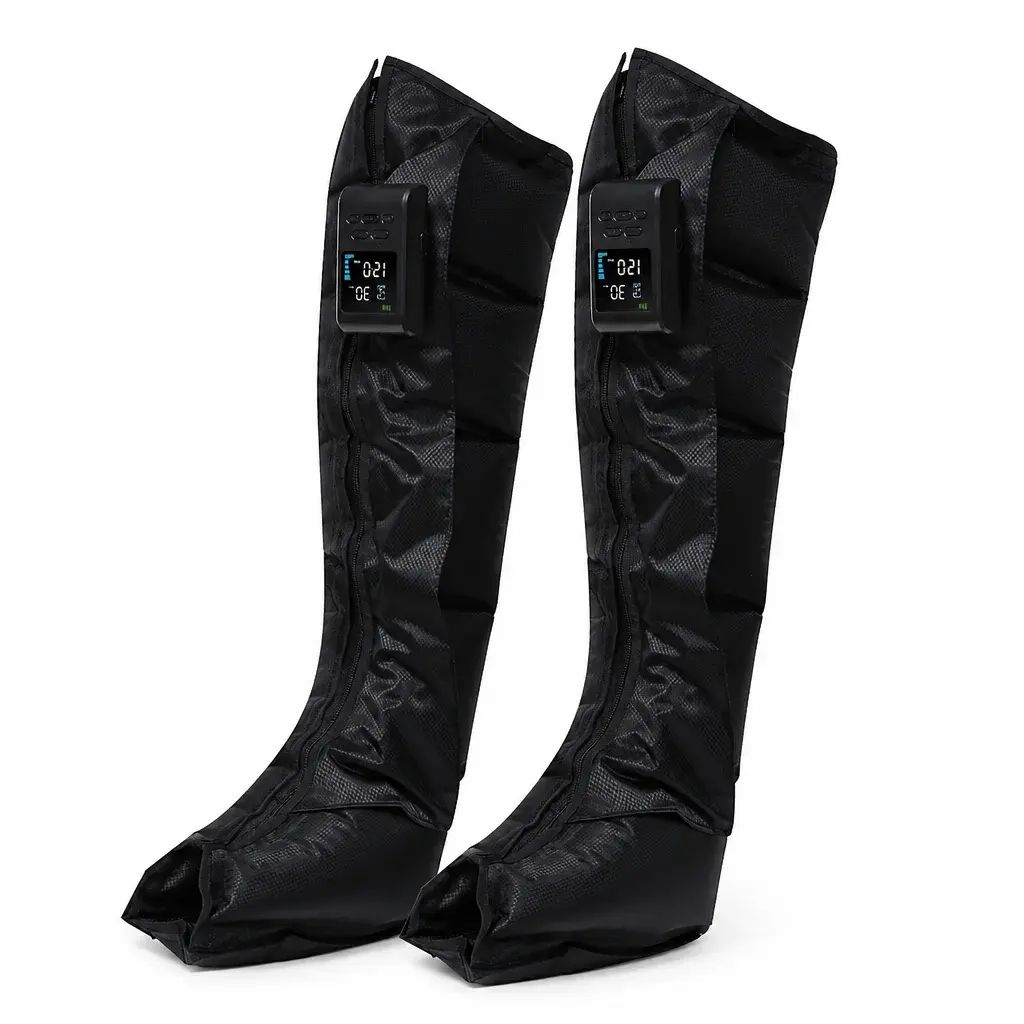
The real test of any performance fabric is whether it still looks and feels right after a long run, a hard session, and dozens of wash cycles. Nylon and polyester blends handle sweat well because they dry quickly and hold their shape, but the addition of elastane is what gives the material enough give to move through squats, lunges, and overhead work without bagging out. A tightly knit construction also stops sweat from pooling on the skin and keeps the fabric from turning clingy or heavy.
Stretch alone is not enough if the fibers lose their snap after a few months. High-quality versions use a higher percentage of elastane or a more resilient knit so waistbands and cuffs do not become loose. Flatlock seams, reinforced gussets, and bonded hems reduce the friction that causes pilling and wear in high-movement areas. That combination is what makes the difference between gear that feels broken in and gear that is simply broken.
Over time, the best materials resist fading, pilling, and odor buildup. Some synthetic yarns are now spun with a softer, cotton-like hand while still drying faster than cotton. Merino blends are another option for lower-intensity days because they handle temperature shifts well and stay fresh longer. When all three factors are balanced, the result is clothing that does not just survive daily use but keeps earning its place in the rotation.
Heat Control Tests Most Buyers Never See
Most buyers assume a heat control system works because the unit turns on and the display reads a believable number. What they don’t see is the bench test where a thermal probe is taped to the heating element and the controller is forced to hold 185°F for six straight hours while ambient temperature drifts. The pass mark is not just reaching the target, but how tightly the curve stays around it—usually within a few degrees, not the fifteen-degree swing that cheaper builds allow.
There is also the shutdown test that rarely gets mentioned. A properly tested unit has to fail safe when a sensor is disconnected or when the chamber overheats past a hard limit. That means wiring in a resistor to simulate a sensor fault, watching whether the relay opens fast enough, and repeating it at different voltage levels. If the board hesitates or the firmware ignores the fault for more than a second, the unit gets pulled from the batch.
Then comes the ugly part: the repeated cold start. The assembly is chilled for a few hours, powered on, run to its maximum duty cycle, and shut down again. After enough cycles, solder joints and terminal blocks start to reveal themselves. Most buyers never see these tests because they are slow and boring to film, but they separate hardware that survives the first winter from hardware that survives the fifth.
The Quiet Work Behind Consistent Air Pressure
Steady air pressure rarely comes from one expensive upgrade. It comes from a pressure switch that still trips at the right point after ten thousand cycles, a drain valve that gets opened at the end of a shift, and a receiver tank sized to absorb the sudden pull of a tool starting up. Without those unglamorous pieces working together, the compressor ends up cycling too often or not enough, and the line pressure drifts just when the work gets demanding.
What makes it tricky is that air behaves like a spring. The moment a valve opens downstream, the pressure at the regulator drops before the switch can respond. A well-set system doesn't chase that drop; it anticipates it through stored volume and a narrow pressure band. That setup takes time to tune, because temperature, filter loading, and hose length all shift the response slightly from one season to the next.
Most of the work is deliberately boring. Someone walks the line listening for leaks, replaces a fitting that has been overtightened one too many times, and adjusts the regulator by feel while watching a needle settle. These small habits do more for repeatable pressure than adding another horsepower ever will.
Electrical Safety Runs Deeper Than the Power Cord
Anyone who has worked around electronic equipment knows the obvious rule: don't yank the cord, don't overload the strip, and keep liquids at a safe distance. But real electrical safety starts long before the plug meets the wall. It begins with how a device is handled, how it is stored, and how its internal paths for current are protected from conditions we rarely think about. A power cord is only the visible end of a much longer chain of decisions.
Inside any piece of gear, small traces, connectors, and insulation layers carry current through tight spaces. Dust, humidity, and repeated thermal cycling can degrade those pathways even when the outside looks untouched. A machine that has never been dropped may still develop a high-resistance joint after years of being powered on and off in a hot studio. That hidden weak point can generate heat without ever tripping a breaker or showing a spark.
Paying attention to how equipment feels and smells during operation, keeping ventilation paths clear, and checking that mounting screws and grounding straps remain firm are all part of electrical safety. The cord matters, but it is rarely the first thing to fail. Treat the whole device as part of the circuit, not just the part that reaches the outlet.
Why Samples Get Run Through Daily-Use Simulations
Lab tests can tell you a lot about tensile strength and chemical resistance, but they rarely show how a zipper copes with a pocket full of keys, a shoulder strap rubbing against a jacket, or a bottle rolling around in a backpack. Daily-use simulations fill that gap by reproducing the small, repeated stresses that accumulate over weeks and months. Instead of one dramatic failure, most products break down through many ordinary interactions.
These simulations also capture the way materials behave together in real conditions. Heat, humidity, body oils, dust, and slight variations in movement all act on a product at once. Running samples through a routine that mimics actual use makes it easier to spot weak seams, loose hardware, or finish wear before those issues reach a customer.
FAQ
It checks for sharp edges, secure wiring, stable attachment points, and materials that do not irritate skin after prolonged contact. Heat elements are tested so they never exceed a set temperature range, and automatic shutoff features are verified under repeated use.
Each motor is calibrated to stay within a defined speed and intensity range. Production lines use reference units to compare output, and random samples are pulled to confirm that vibration remains steady without sudden jumps or excessive noise.
Because a device may work well for ten minutes but fail after many sessions. Durability testing simulates weeks of regular use in a shorter time, exposing weaknesses in straps, heating pads, motors, and outer fabric before the product reaches customers.
The device is put through overvoltage, leakage current, and insulation resistance tests. Charging ports and battery compartments are inspected for overheating, and the power-off behavior is confirmed under low battery and charging fault conditions.
Heating pads include multiple temperature sensors and a control circuit that cuts power if the surface gets too warm. Factories also run thermal mapping tests to confirm heat spreads evenly instead of concentrating in one small area.
The contact surface is usually made from breathable, non-toxic fabric that resists wear after repeated bending. It must pass skin contact safety assessments, remain soft after cleaning, and keep its shape around the knee without causing friction burns.
Yes. Factories test the strap length, elastic tension, and pad positioning on various knee circumferences. The goal is to keep the massage nodes aligned with the joint while preventing the device from sliding or pressing too tightly.
Conclusion
By the time a knee massager is packed and ready to ship, it has already passed a series of checks that most customers never see. The devices are pulled from production lines and put through inspection points that look beyond basic appearance. Seams are stretched, straps are tugged, and materials are exposed to sweat-like moisture to make sure they will not crack or peel after weeks of use. Heat settings are monitored with sensors placed inside the pad, not just on the surface, so the warmth stays within a narrow range that is comfortable but not risky. Air pressure systems are run through repeated inflation and deflation cycles, with leaks and weak valves flagged before a unit ever reaches a warehouse.
Electrical safety goes further than checking the power cord. Internally, insulation, grounding, and current leakage are tested under conditions that mimic a home with unstable voltage or damp air. Samples from each batch are also run through daily-use simulations, where the massager operates for hours, rests, then starts again, mimicking weeks of real-world use in a compressed time frame. These routines catch slow failures that a quick on-off test would miss. Taken together, the standards form a quiet but thorough gate: every device that makes it out has already proven it can handle heat, pressure, moisture, and repeated use without putting the user at risk.
Contact Us
Contact Person: Hannah
Email: [email protected]
Tel/WhatsApp: +86 18266954198
Website: https://www.okmassager.com/