China Crystal Label Manufacturer: Your Partner for Premium Custom Crystal Labels
2026-11-16
A crystal label isn't just a tag—it's the first thing your customer touches. If you're sourcing from a China crystal label manufacturer, you need more than glossy film; you need a partner who obsesses over edge smoothness, adhesive clarity, and dimensional depth. That's exactly what Xinsen brings to the table. Here's how we help premium brands outshine the shelf.
What Actually Goes Into a Crystal Label That Lasts a Decade
Most people assume a crystal label's lifespan comes down to the ink, but the real work starts underneath. The film has to be cut from a polyester or polycarbonate roll that won't shrink or wave after a few summers in a warm kitchen. Its underside carries an acrylic adhesive blended for glass—not the same tack you'd use on paper or plastic. Once that adhesive wets out against the crystal, it needs a day or two to fully cure, which is why rushed production often ends with labels curling at the corners.
Above the film, the printed layer gets treated less like decoration and more like a protective skin. UV-cured pigments replace dye-based inks, and a thin ceramic coat can be added for scratch resistance. Then a clear laminate cap is extended just past the label's edge. That tiny overhang is often the difference between a label that laughs off dish soap and one that lets water sneak in and fog the adhesive. Ten years might sound like a lot, but with the right film, cure time, and edge seal, it's more about patience than magic.
Our Design Intake Process: No Detail Gets Lost in Translation
Every project starts with a conversation, but we take it further than a quick chat. Our intake form asks the kinds of questions that surface the small things clients often forget to mention—file naming habits, the exact tone they hate, or that one stakeholder who always needs final sign-off. It’s structured enough to be consistent, yet flexible enough that nothing feels like a rigid checklist.
Once the form lands in our hands, a senior designer reads it end-to-end before any sketch is made. We flag contradictions, follow up on vague phrases, and pin down what “clean and modern” actually means for this particular team. That extra pass catches the details that usually slip through between a kickoff call and the first draft.
The result is a brief that designers can actually work from without guessing. No lost requirements, no re-explaining the same thing three times, no “I thought you meant X” moments two weeks in. It’s not glamorous, but it’s why our handoffs feel calm instead of chaotic.
Why We Test Crystal Labels Against Heat, Cold, and Humidity
Crystal labels face a surprising range of environmental stress once they leave the production line. A shipping container crossing the equator can bake at 140 degrees Fahrenheit, while a truck crawling through a northern winter can subject the same package to sub-zero temperatures. If the adhesive softens in heat or the face stock becomes brittle in cold, the label fails before it ever reaches the shelf. We test against these extremes because a label that looks perfect on a climate-controlled bench is not necessarily one that will survive a real-world supply chain.
Humidity is the quieter killer. High moisture levels can fog the crystal-clear overlay, cause paper liners to warp, or break down the bond between layers. Even a brief exposure to condensation inside a sealed polybag can leave permanent streaks or bubbles. By cycling labels through controlled humidity chambers, we see exactly how the material behaves when the dew point rises, and we adjust the coating or adhesive formula before a single roll ships.
These tests are not about chasing a laboratory benchmark; they are about preventing the kind of failure that costs a customer a full day of repackaging. A crystal label that holds its clarity through a heat wave, a deep freeze, and a muggy warehouse is one that earns its place on a premium product. That is why every batch gets pushed beyond the comfortable middle range, so the only surprises left are pleasant ones.
The Difference Between a Good Crystal Label and a Great One
A good crystal label does its job: it sticks, it looks clean, and it tells you what the product is. But a great one does something more subtle. It makes you pause for half a second and feel that the object in your hand is somehow taller than its physical size. That pause is where the difference lives. It is not about louder colors or thicker foil — it is about restraint, the kind of restraint that whispers instead of announces.
Think about how light moves across the surface. A good label reflects light; a great label seems to hold it for a moment before letting go. This comes from choice of material, sure, but more from the tension between blank space and printed detail. Most manufacturers crowd every micron with logos and legal text. The great ones treat emptiness as a design element, letting the crystal itself do the talking. When you see that balance, you are not reading a label anymore — you are observing a small, deliberate piece of theater.
Then there is the matter of touch. A good label feels flat and forgettable under your thumb. A great label has a texture that invites your finger to trace a letter or an edge, just once. It is the kind of detail that never appears in a spec sheet, but it decides whether the product feels expensive or merely adequate. That is the real split: good labels inform, great ones imply there is a person behind the choice who cared enough to make the ordinary feel unrepeatable.
Custom Crystal Labels for Products You Wouldn't Expect
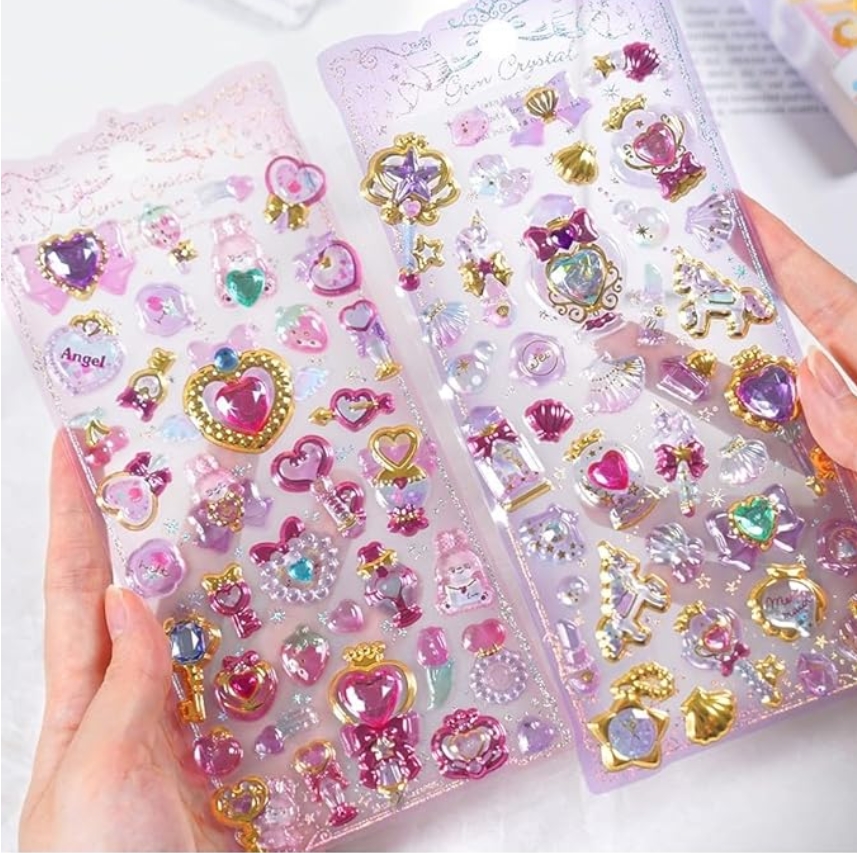
Crystal labels usually bring to mind wine bottles and high-end perfume, but they have a way of sneaking onto objects you'd never pair with anything sparkly. A bag of single-origin coffee with a clear, faceted label turns a morning pour-over into a tactile ritual. A terracotta plant pot tagged with a slim crystal strip catches window light and makes the greenery feel curated, not just watered.
Think about the tools and gear that live in drawers or garages. A chisel handle, a leather notebook cover, or the deck of a skateboard can wear a crystal label without looking fragile. The material holds up to scuffs, water, and daily handling far better than paper, so the label stays legible while adding a subtle weight that hints at quality.
For small-batch makers, this is the difference between packaging that gets tossed and packaging that gets kept. A crystal label doesn't shout; it gives an ordinary product a quiet reason to be noticed, touched, and remembered long after the purchase.
What Happens After You Send Us Your First Sample Request
Once your request lands in our system, it goes straight to a person, not a queue of automated replies. You’ll get a short confirmation note within one business day, usually with the name of the engineer or product specialist assigned to your case.
That specialist then pulls your specifications, checks current stock or production timelines, and flags anything that could slow things down. If a dimension, tolerance, or material choice seems off for your intended use, you’ll hear about it before samples go out.
Most first-sample requests ship within three to five working days. You’ll receive a tracking number as soon as the package leaves our facility, plus a direct contact for any follow-up questions.
FAQ
A crystal label is a decorative badge made from resin or glass crystals that adds a dimensional, high-shine finish to garments, bags, or footwear. Unlike flat woven labels, it catches light and creates a premium, jewelry-like effect that many brands use to elevate their products.
Yes, we build a new mold for every design you send, so the shape isn't limited to standard options. You can specify exact dimensions, choose from dozens of crystal colors, and even mix different sizes of stones within one label.
Our standard MOQ starts at 500 pieces, but for first cooperation we often accept 200 to 300 pieces so you can test the market. Complex designs with many crystals may have a slightly higher starting quantity due to mold costs.
After you confirm the digital proof, we produce a physical sample in about 5 to 7 days. Bulk production usually takes 10 to 15 working days, and air shipping adds another 3 to 5 days depending on your location.
We use eco-friendly resin and lead-free glass crystals that pass REACH and CPSIA testing. The adhesive and backing are also chosen to be non-toxic, so the labels are safe for children's clothing and accessories.
Each crystal is set into a molded resin base with a mechanical lock, not just glue. After setting, we run every batch through a 10-cycle wash test and a pull-strength check to ensure the stones stay in place.
Absolutely. Our in-house designers will take your sketch or even a photo and convert it into a clean vector mockup for free. We'll suggest the best crystal sizes and spacing to make the design readable at your label's actual size.
We specialize only in crystal labels, not general trims, so our molds, setting techniques, and quality control are tuned for this product. You also get one dedicated project manager who updates you with photos at every stage, from mold opening to final packing.
Conclusion
A crystal label that survives ten years of daily handling is not an accident. It starts with the right resin, the right curing schedule, and a manufacturer who understands how thickness, dome clarity, and adhesive interact. We have seen too many labels fail because someone skipped a stress test. That is why every batch we produce goes through thermal cycling, humidity exposure, and adhesion checks before it leaves our floor. You might not think a crystal label belongs on a motorcycle helmet, a fishing reel, or a surgical instrument case, but we have made all of those work. The difference between a good label and a great one often comes down to edge polish and optical purity—details that are invisible in a photo but obvious in your hand.
Our intake process is deliberately low-tech on your side and high-rigor on ours. Send us a sketch, a photo of your product, or just a rough idea of where the label will live. We ask about surface texture, exposure to sunlight, and whether the label will be touched once a week or fifty times a day. Those answers shape the material choice and the dome profile. After your first sample request, you get a physical proof to bend, scratch, and freeze. We do not rush that step, because a label that looks perfect on screen can feel wrong in person. That back-and-forth is where most custom projects are won or lost, and it is why we treat every inquiry like the start of a long production run, not a one-off transaction.
Contact Us
Contact Person: Yara
Email: [email protected]
Tel/WhatsApp: +86 13505426090
Website: https://www.qdxspack.com/