

Best Arc Fault Detection Devices for Ultimate Home Electrical Safety
2026-08-24
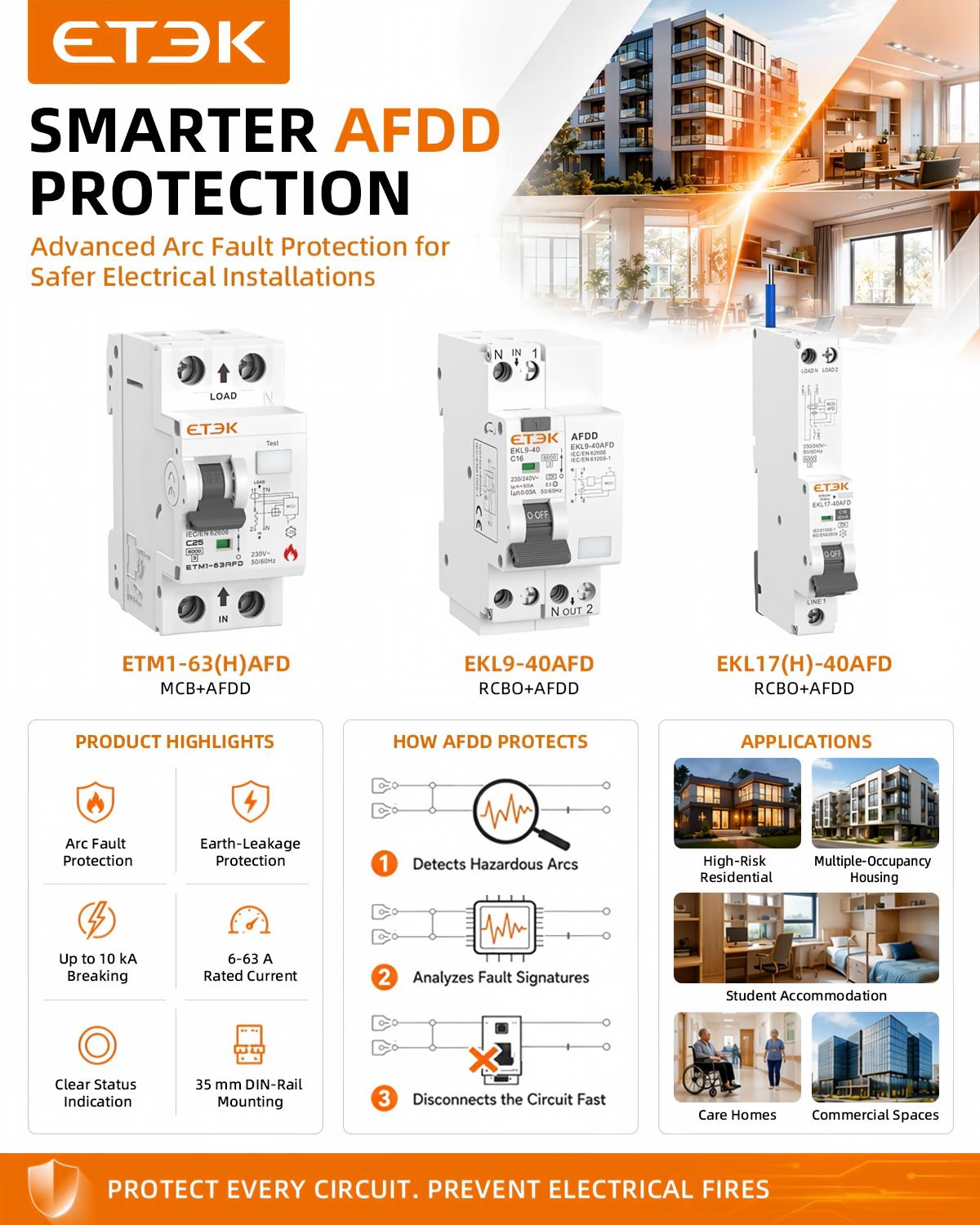
Ask any electrician what keeps them up at night, and arc faults will likely make the list. These hidden electrical arcs can burn at thousands of degrees inside your walls, often without ever tripping a standard breaker. That's why choosing the right arc fault detection device isn't just a code requirement—it's the backbone of truly proactive home protection. In this guide, we compare the best options on the market, from trusted names to standout performers like ETEK, whose detection technology catches dangerous arcs before they become disasters. If you're serious about upgrading your home's electrical safety, this roundup will point you to devices that actually deliver.
Why Standard Breakers Leave a Dangerous Gap
Most people assume that if a circuit breaker trips, the risk is gone. That mindset works for overloads and dead shorts, but it misses a quieter threat. A standard breaker reacts only after current has already surged far beyond normal levels. Arcing faults—where electricity jumps across a loose connection or damaged wire—often stay below that tripping threshold while still generating enough heat to ignite surrounding materials.
That gap between what a standard breaker senses and what actually starts fires is where homes remain exposed. An arc can smolder behind a wall for months, gradually charring wood or insulation, without ever pulling the kind of amperage that would flip a traditional thermal-magnetic breaker. Until the breaker is designed to recognize the signature of an arc, it simply watches the problem evolve without stepping in.
The Silent Warning Signs Your Wiring Is Arcing
Arcing often gives itself away through sounds and smells before you ever see damage. A faint sizzling, crackling, or popping noise coming from an outlet, switch, or inside a wall is a classic clue that electricity is jumping where it shouldn't. You might also notice an acrid, fishy, or burning plastic odor near receptacles or your breaker panel, even when nothing appears hot to the touch.
Visual hints can be just as telling once you know where to look. Charred or discolored outlet covers, scorch marks around plug prongs, or flickering lights that dim when an appliance kicks on are all signs that a connection is loose enough to produce heat. In some cases, you may see a brief blue spark when unplugging a device, but repeated, bright, or lingering sparks are not normal and point toward internal arcing.
Because arcing can happen inside walls and junction boxes, the warning signs are easy to dismiss as quirks. If you hear intermittent buzzing behind drywall, notice warm spots on a wall, or have breakers that trip without an obvious overload, stop using that circuit and have an electrician inspect it. Arcing is a leading cause of electrical fires, and catching these quiet signals early is far cheaper than repairing fire damage later.
How Arc Fault Detection Devices Intercept Trouble Early
Arc faults often begin as tiny, invisible breaks in wiring or connections—loose terminals, pierced insulation, or aged cables. A standard breaker won't notice these low-current anomalies until they grow into a full-blown short or fire source. Arc fault detection devices, by contrast, continuously monitor the waveform for the chaotic, high-frequency signatures that accompany arcing. Think of it like catching a whisper of smoke before you ever see flames. The device samples electrical noise thousands of times per second, distinguishing harmless arcs (like a switch turning off) from dangerous ones that sputter and flicker unpredictably.
Once the signature matches a known fault pattern, the device doesn't wait for heat to build or current to spike. It trips the circuit in a fraction of a second—often fast enough to prevent molten metal from splashing onto nearby combustibles. In older homes, a loose outlet behind a bookshelf could smolder for weeks; with an AFDD in the panel, that same condition gets interrupted during its first few erratic cycles. The real advantage is that it acts on the cause of the fire, not the symptom. By catching trouble while it's still just a sputtering electron, these devices buy hours or even days of lead time that a conventional overcurrent or ground-fault protector simply can't provide.
Field data from retrofitted buildings shows a marked drop in electrical fire callouts once AFDDs enter the panel. Electricians report nuisance trips are rare when the devices are properly matched to the circuit's normal load profile. Installation is straightforward, but the subtlety lies in reading the diagnostic LEDs—blinking codes reveal whether the device saw a series arc, a parallel arc, or a ground leakage, guiding repairs before the circuit gets re-energized. That feedback loop turns every trip into a learning moment for the maintenance team, shrinking the window between first spark and full interruption to a matter of milliseconds.
Top Devices That Balance Sensitivity and Nuisance Tripping
Finding a protection device that responds quickly to real hazards while ignoring harmless fluctuations is harder than it sounds. Many older models either trip too easily or wait too long. But newer designs use signal filtering and pattern recognition to distinguish between a true arc fault or ground leakage and everyday electrical noise from things like vacuum cleaners or LED dimmers.
Among standouts are combination AFCIs that analyze high-frequency signatures rather than raw current spikes. Some premium GFCI receptacles now include adjustable sensitivity settings hidden behind the faceplate, letting you dial back nuisance trips in workshops or kitchens without sacrificing safety margins. Devices with built-in self-monitoring also help because they can warn before a sensor drifts into over-sensitivity.
Ultimately the best choices pair variable response curves with thermal-magnetic backup, so a slow-developing overload trips one mechanism while a fast arc trips another. This layered approach keeps the breaker from crying wolf during motor startups, yet still opens within milliseconds of a dangerous fault. That is the balance most homeowners only notice by what doesn't happen.
Where to Place Detectors for Whole-Home Coverage
Getting detectors into the right spots matters more than buying extra units. Start with the sleeping areas: put one in the hallway outside every bedroom, and if any bedroom doors stay closed at night, consider adding a detector inside that room as well. You also need at least one on each level of the house, including a finished basement, because smoke and carbon monoxide behave differently depending on where they originate.
In kitchens and bathrooms, keep detectors at least a few feet away from cooking appliances and shower steam to cut down on nuisance alarms. That said, don't push them so far that they miss real problems. A detector near the kitchen but not directly over the stove, and one just outside a bathroom door, usually strikes the right balance.
Mount detectors high on walls or on the ceiling, following the manufacturer's instructions for spacing from corners and vents. Avoid placing them behind curtains, furniture, or in dead air pockets like the peak of a cathedral ceiling. If you have multiple units, linking them together so one alarm triggers the rest is the most dependable way to wake everyone up no matter where the danger starts.
Upgrading an Older Panel Without Rewiring Everything
Many older electrical panels get replaced simply because the enclosure or the bus bars have degraded, not because the wiring throughout the house is faulty. If your branch circuit wires are still in good shape and the insulation isn't brittle, you can often swap in a new panel and reuse those existing runs. This cuts the job down to a focused upgrade at the panel location instead of tearing open walls to pull new cable everywhere.
One common path is replacing a fuse box with a breaker panel while keeping the original circuits connected. Another option is adding a subpanel next to the main panel to gain extra breaker slots, which avoids the need to rewire older circuits just to create space. In many homes, the existing wiring can handle a modern breaker setup as long as the wire gauge matches the load.
Before committing to a panel-only upgrade, have an electrician check the condition of the wire insulation and confirm that the grounding system meets current code for the new panel. Loose connections at the old panel sometimes damaged the first few inches of a conductor, so a short pigtail or a junction box may be needed there. But the bulk of the in-wall wiring usually stays untouched, which keeps the project faster, less invasive, and significantly cheaper than a full rewire.
FAQ
They monitor the current waveform for characteristic signatures of arcing—high-frequency noise, rapid voltage fluctuations, and irregular zero-crossing patterns. Unlike a standard breaker that only reacts to overcurrent, an AFDD's microcontroller continuously compares the electrical signature against known arc profiles, ignoring harmless arcs from things like brushed motors or light switches.
It depends on the panel. Most AFDDs are designed for DIN rail mounting in modern consumer units with circuit breakers. Older fuse boxes often lack the neutral and space requirements. You'd likely need a panel upgrade or a retrofit kit if available. A licensed electrician can assess whether your existing enclosure can accommodate the device safely.
Bedrooms, living areas, and circuits serving older wiring or hidden junctions are prime candidates because arcs often start in damaged insulation behind walls. Kitchens and workshops with high-wattage appliances also benefit, but nuisance tripping may occur with certain motor loads, so placement should balance risk and practicality.
No, they complement those devices. An AFDD typically includes overcurrent protection and sometimes ground fault protection, but it doesn't eliminate the need for proper circuit breaker coordination. In many installations, you'll still use a standard MCB upstream or choose a combined AFDD/MCB unit. GFCIs remain essential for shock protection in wet areas.
Brushed motors produce electrical noise and micro-arcing that can mimic dangerous arc signatures. Older or poorly designed AFDDs have trouble distinguishing between a harmless commutator spark and a parallel arc fault. Newer units use advanced algorithms and sometimes adjustable sensitivity to reduce false trips without compromising safety.
Most manufacturers recommend pressing the test button monthly or quarterly to verify the internal self-test circuitry works. The device itself has no mechanical parts to wear out like a fuse, but the electronics can degrade over 10-15 years. If the test button fails to trip the unit, replace it immediately. Some models have an end-of-life indicator.
Series arcs occur along a single conductor where a connection is loose or broken, while parallel arcs jump between two conductors (line-to-neutral or line-to-ground). A quality AFDD detects both, but series arcs are trickier because current is limited by the load and may not exceed normal operating levels. Check the device specifications for both detection modes.
Requirements vary by region. In the US, the NEC has phased in AFCI requirements for bedrooms and later most living areas in new construction. In Europe, IEC standards and some national codes require AFDDs in certain high-risk locations like wooden-frame buildings or sleeping accommodations. Always check local amendments because enforcement varies widely.
Conclusion
Homeowners often assume a breaker panel is the last line of defense, but standard circuit breakers only trip for overloads or dead shorts. They miss the low-current, unstable arcing that quietly eats away at wire insulation and can ignite framing inside walls. You might hear a faint crackling behind an outlet, see lights flicker for no obvious reason, or notice a lingering acrid smell near a switch plate—these are the early warnings that a connection is failing. Arc fault detection devices read the electrical noise signature of those dangerous arcs and cut power within milliseconds, well before heat builds to a fire. The tricky part is tuning them so they don't trip every time you use a drill or a vacuum; the best models use advanced algorithms that can tell a harmless brush spark from a genuine parallel or series arc.
For proper coverage, put AFDD breakers or outlets on circuits that feed bedrooms, hallways, and any older wiring you suspect is brittle or chewed by rodents. Retrofitting an existing panel rarely means rewiring the house—many units drop into standard breaker slots, and tandem versions can free up space without a costly panel swap. If you have a subpanel or a few spare slots, you can phase in protection room by room over a weekend. Look for models with trip logs or indicator lights that help you diagnose whether an event was a real arc fault or just a noisy appliance. Stick with units certified to UL 1699 or the equivalent in your region, because no-name copies often sacrifice the very sensitivity that saves lives. Replacing a chronically tripping old device—like a worn-out bathroom fan or a frayed extension cord—also reduces nuisance calls. The goal isn't just adding gadgets; it's turning your electrical system into something that warns and stops fires before the smoke detector ever has to wake you.
Contact Us
Contact Person: Andy
Email: [email protected]
Tel/WhatsApp: +86 13356133008
Website: https://www.etek-china.com/